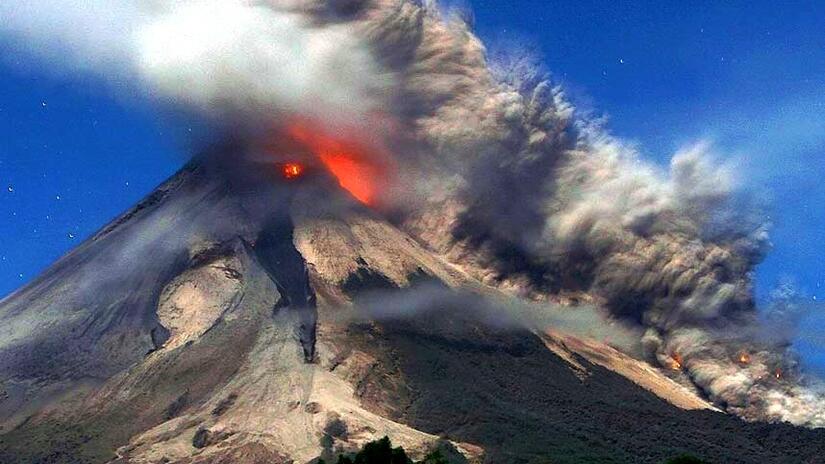
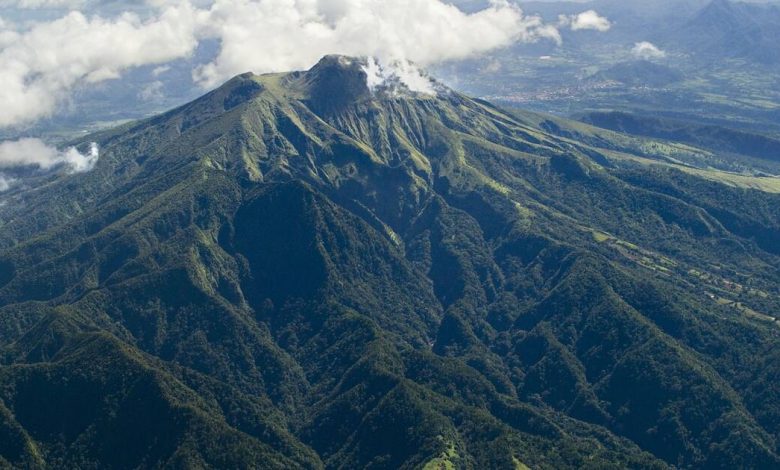
Recent advances in volcanology point to new possibilities for predicting volcanic eruptions, an issue that is of particular concern to the residents of the Martinique in the face of the constant threat of the Mount Pelée.
In an article published on February 13, 2026, Imaz Press highlights an innovative method developed by geophysicists to predict an eruption with statistically significant reliability a few hours before the event begins. This technique, known as the «jerk method,» is based on the analysis of signals from seismological stations and, according to its authors, would make it possible to detect a signal indicating an impending eruption up to eight hours before it occurs in most of the cases observed during tests conducted at Piton de la Fournaise, a volcano on Réunion. .
This breakthrough adds to the body of traditional methods used by volcanologists to monitor these dormant giants. Around the world, networks that combine seismology, ground deformation monitoring, volcanic gas analysis, and thermal measurements are now essential for monitoring a volcano's activity and trying to predict its behavior. These instruments make it possible to detect seismic events, ground swelling, or abnormal gas emissions, signs observed prior to many past eruptions. .
The Mount Pelée, an active stratovolcano, is under constant monitoring by the’Martinique Volcanological and Seismological Observatory (OVSM-IPGP). Recent reports indicate ongoing, albeit moderate, volcanic seismic activity, with dozens of volcanic earthquakes recorded regularly; however, no parameters currently suggest an imminent eruption. The OVSM-IPGP is responsible for interpreting all data to establish appropriate alert levels and inform the authorities and the public.
Despite the progress, Accurately predicting a volcanic eruption remains an imperfect science. The data show that while precursors are often visible before an eruption—earthquakes, ground deformation, changes in gas emissions—there is still no single, 100 % reliable signal to predict a volcanic awakening. Each volcano has its own internal dynamics, which makes it difficult to generalize about forecasting methods. .
This raises a pressing question in Martinique: Is it really possible to predict an eruption of Mount Pelée and thus protect the population? The answer, for now, lies in the combines multiple surveillance techniques and the scientists' vigilance. The work of researchers, both locally and internationally, helps improve early-warning systems and reduce uncertainties. But the complexity of volcanic processes means that only a Constant vigilance combined with transparent communication with the public can now offer optimal protection. Advances such as the "jerk" method, however, give cause for optimism by showing that it is possible—even if only a few hours beforehand—to detect warning signs before a volcano's power becomes evident on the Earth's surface.
Philippe Pied