The environment is in danger, countless species are disappearing every day, glaciers are melting before our very eyes, the climate has gone haywire, humanity is sick…The list of signs pointing to an urgent need for action has been long for quite some time, and a significant segment of civil society did not wait for the diplomatic agreements reached at the most recent COP 21 in Paris to change course in their lifestyles. Numerous initiatives around the world have preceded and inspired political decisions on environmental protection and the energy transition. Martinique has been no exception in recent years, and an environmental consciousness is emerging as the architects of this transition work and educate others toward a world that is more respectful of nature and humanity. Here’s an overview!
On the Island of Flowers, as elsewhere, the elders were undoubtedly the first to observe the signs of an unprecedented upheaval in nature: First, the sky changed; time seemed to speed up. There were more and more cars, more consumption, more administrative hassles weighing on people’s minds. Then we learned that the land had been poisoned by chemicals, but it took a long time for anyone to speak up. we saw the sea literally suffocated under waves of Sargassum without finding a solution; finally, we began to hear about diseases that had practically never existed here before, such as cancers… And these days, three major hurricanes are wreaking havoc across the Caribbean! But that’s not all. Just like the environment, society is sick; human relationships have become commercialized as they’ve drifted further from nature, and the whole world is racing to consume useless things produced at the expense of the environment and human life. We are in a situation of total exploitation of nature’s and humanity’s resources, for the benefit of a handful of people.
Since the 1950s, various movements have sought alternatives, and many scientists have tried to alert society to the risks of environmental degradation—risks that Commander Cousteau was already warning about 50 years ago! In 1949, researcher Fairfield Osborn wrote: « »Humanity risks bringing about its own ruin through the ceaseless and universal struggle against nature more than through any war."
These movements, though viewed by consumer society as marginal, hippie-like, or eccentric, were in fact pioneers of a holistic approach to life—one that recognizes the interconnection of all things in nature, of which humanity is a part. In fact, current research is now bringing these valuable interactions to light.
It has become abundantly clear that a portion of humanity is exploiting nature’s resources and the potential of human labor to the absolute limit. The global economic model is based on this logic and gives rise to artificial poverty and the depletion of life in all its forms. Food—and its destructive production methods—as well as energy lie at the heart of the problem that is leading to an unprecedented crisis of civilization. Politicians, in the pay of industrialists, are shaping and regulating a society that has become inhumane, and everywhere, people are rising up.
Pierre Rabhi, humanist, farmer-philosopher, and founder of the Colibris movement calls for «an uprising of consciences». He is one of the pioneers of this school of thought, which advocates a holistic approach to life in all its preciousness, irreplaceability, and wonder: «…it is to an uprising and a uniting of consciences that I call today, to pool the best that humanity has to offer and avoid the worst. This coalition seems to me more essential than ever, given the scale of the threats hanging over our shared destiny—threats that are largely due to our grave transgressions…». Pierre Rabhi invites us to reconnect with the earth!
Be the change you want to see in the world
Martinique has seen its once-bountiful natural environment deteriorate over the past few years. More and more initiatives are emerging to reverse this trend, primarily in the area of food production. Reversing this trend means changing our attitudes and consumption habits by prioritizing short supply chains—from producer to consumer—to minimize transportation and ensure sustainability for the sake of the land and human health; it means ending waste, recycling, and using local materials in production processes; It means carpooling and switching to alternative energy sources; it means modifying our homes to make them self-sufficient and energy-efficient… It means stopping believing that our planet’s resources and its capacity to absorb pollution are inexhaustible!
 From farm to table: baskets of fresh, local produce
This overview of initiatives cannot be exhaustive, as there are far too many of them in our region, but it aims to encourage people to look around them, see what is changing, and consider how they can embrace that change through simple consumer choices. It focuses specifically on food self-sufficiency. Several small producers on the island offer their organic or natural products directly to consumers, such as « Waël's Flavors »in François or" «Little Coconut Tree" *», a cooperative of small producers from the north who are committed to eco-friendly consumption: reducing waste (packaging) and transportation, and promoting the local production and consumption of fresh, seasonal products using natural farming methods. As “Les saveurs de Waël” states on its website, the most important thing is «Everyone should care about what they eat!»

Aquaponic system
Among the experimental gardens and community gardens where people grow crops and teach alternative techniques
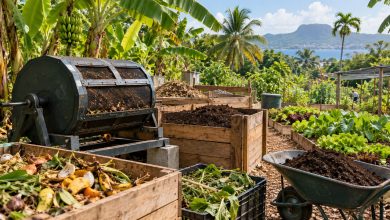
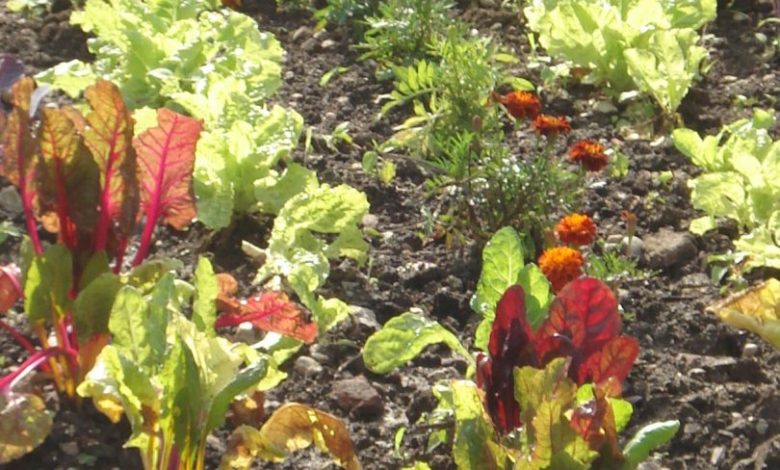
Community gardens stem from an ancient tradition based on mutual aid, the pooling of resources, and the sharing of knowledge. There are several such gardens in the area, covering various fields—some of which draw on traditional and/or innovative techniques, such as companion planting and composting… Examples include Dillon's Medicinal Garden in Fort-de-France, a community garden in the Dillon neighborhood featuring medicinal, aromatic, and vegetable plants; it is a social integration garden that is open to the public. Of course, there is The Community Gardens of Anse Gaïac* in Le Prêcheur (see our sidebar) who practice agroforestry and permaculture techniques based on the theories of syntropy and pass on these techniques. The Gardens of Macabou* In Le Vauclin (see our sidebar), residents have demonstrated in just a few years that it is possible to grow and harvest fruits, vegetables, and forage on arid land without water, using permaculture and biomimicry techniques. And then, all over the place, there are private gardens shared in the city—at the base of apartment buildings—or in the countryside, whether among neighbors or within families. The goal is food self-sufficiency, and Hurricane Irma in Saint Martin proves, if proof were needed, that in our island communities, we must first rely on ourselves when it comes to survival.
Nathalie Laulé
- Articles on the martinique2030.com website
A few definitions:
Colibris Movement: Colibris is a nonprofit organization founded in 2007 by Pierre Rabhi. The organization proposes a new vision for an ecological and socially responsible society, based on simplicity, self-sufficiency, and sharing.
Permaculture: Permaculture is a science of designing crops, living spaces, and human agricultural systems using ecological principles and the knowledge of traditional societies to replicate the diversity, stability, and resilience of natural ecosystems.
Agroforestry: Agroforestry refers to practices—both new and traditional—that combine trees, crops, and/or animals on the same agricultural plot, either along the edges or in the middle of the field. These practices include agroforestry systems as well as silvopastoral systems and pre-orchards (where animals graze beneath fruit orchards)… (from agroforesterie.fr)
Biomimicry: Biomimicry is a multidisciplinary approach that involves studying nature’s models and replicating the essential properties (shapes, materials, or processes) of biological systems in order to solve technological problems. (from the Biomimicry and Chemistry TPE)
Syntrophy: Growth of fastidious bacteria under seemingly unfavorable conditions around colonies of another species that normally thrive in the studied environment. This phenomenon can be explained by the fact that the fastidious bacterium takes advantage of metabolic factors that it cannot synthesize on its own and that have been released by the other bacterium.