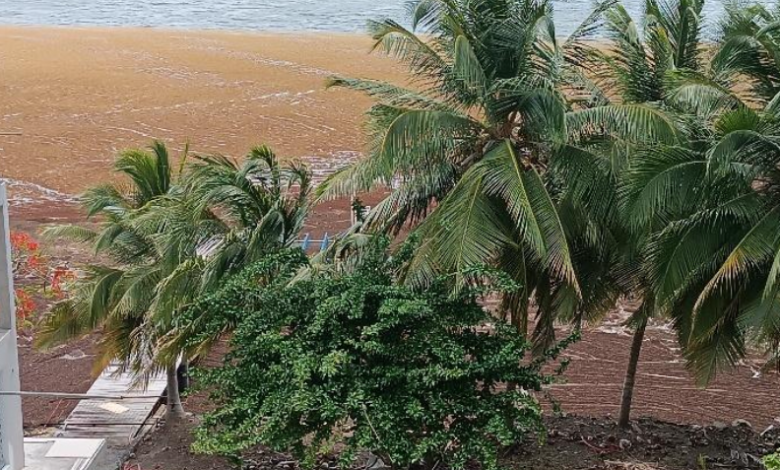
In the ten years that Madininair has been measuring the gases released by the decomposition of Sargassum algae along the Martinique coastline, levels have never been this high. The Air Quality Observatory’s 2025 annual report, released in recent weeks, paints an alarming picture that surpasses all previous records, including the years 2021 and 2022, which had previously been the highest on record.
Unprecedented figures
In 2025, the fixed network of sixteen sensors deployed along the entire Atlantic coastline recorded 913 instances where the daily threshold of 1 ppm of hydrogen sulfide (H₂S) was exceeded at twelve sites, and 81 instances where the 5 ppm threshold—the most critical—was exceeded at five sites. Even more significant: on 218 out of 365 days, at least one site in the network exceeded the 1 ppm threshold. Martinique thus experienced virtually no respite.
The all-time high was recorded on June 21, 2025, at 3:00 a.m. at the Frégate EST 2 site in Le François, with an hourly concentration of 17.25 ppm—a value never before recorded since measurements began in 2015. At this same site, the daily record reached 11.73 ppm, and the sensor exceeded the 1 ppm threshold for 130 consecutive days.
The months of May, June, and July marked the height of this crisis, with 227 instances of the daily threshold of 1 ppm being exceeded in July across the entire network, and 34 instances of the 5 ppm threshold being exceeded in June. But 2025 had another unusual feature: significant peaks in December, an extremely rare phenomenon that attests to the exceptional nature of this year.
Le François and Le Robert: Towns on the Front Lines
The town of Le François stands out as the hardest-hit area, with the sites at Pointe Thalémont and Frégate EST 2 showing the most concerning levels. Le François exceeded the daily threshold of 1 ppm on 41 out of % days of the year at Frégate EST 2, or 151 days. Le Robert ranks second, driven in particular by the sites at Baie Cayol—the only monitoring station to have recorded exceedances every month of the year—Four à Chaux, and Pontalery Nord. The Baie Cayol site alone recorded 170 days of exceedances of the 1 ppm threshold.
The supplemental network, consisting of mobile sensors deployed in areas not continuously monitored, reveals equally concerning levels in sectors that had previously been poorly documented. Pointe Lynch (Robert) recorded 1,882 hourly exceedances—the highest number in the supplemental network—while Pointe Jacques (François) reached a peak of 12.2 ppm.
Ammonia: Below the threshold, but worth monitoring
As for ammonia (NH₃), the results are more reassuring: no site exceeded the regulatory threshold of 8.3 ppm in 2025. The highest concentrations were observed at Four à Chaux (6.1 ppm hourly, 2.4 ppm daily), Dostaly Sud, and Château Paille. However, interannual variability remains significant, and Madininair emphasizes the need for continuous monitoring at these sensitive sites.
A rapidly evolving network
To improve the accuracy of its measurements, Madininair undertook a major spatial optimization effort in 2025, repositioning certain sensors as close as possible to the areas of maximum exposure identified in the neighborhoods and establishing new monitoring sites at Pointe Rouge, Pointe Thalémont, and Anse aux Bois. This expansion of the network partly explains the apparent increase in certain figures: better-placed sensors detect more pollution.
Among the notable advances is the establishment of a so-called «sensitive» network, with sensors installed inside and outside schools in Le Robert and Le François. The goal is to anticipate pollution episodes and support decisions made by the regional education office and the Regional Health Agency regarding classroom management during pollution peaks.
For 2026, a formal agreement between the ARS Martinique and Madininair is currently being implemented to govern the dissemination of alerts to local governments, schools, and authorities. The results of spatial analysis conducted at fourteen new sites in 2025—including Fond Basile, Petit Galion, Macabou, and La Chéry—will serve as the basis for deciding whether to integrate these sites into the fixed network.
A phenomenon that is becoming a long-term trend
Since 2015, there have been a cumulative total of 3,496 instances where the daily threshold of 1 ppm was exceeded across all sites, and 213 instances where the threshold of 5 ppm was exceeded. These figures, when viewed in light of the intensification expected in 2025, serve as a reminder that the Sargassum problem is not a temporary phenomenon. It is part of a long-term regional reality that calls for commensurate responses: strengthening the monitoring network, modernizing sensors, prioritizing cleanup areas, and, above all, protecting the most vulnerable populations, particularly schoolchildren in communities along the Atlantic coast.