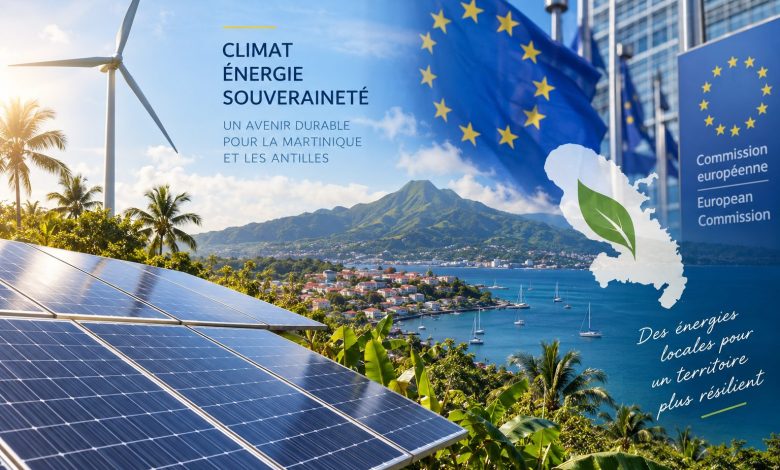
Reducing dependence on imported fossil fuels, generating more electricity locally, expanding renewable energy, and strengthening the power grid and storage infrastructure: Speaking before the United Nations, Ursula von der Leyen presented the energy transition as a matter of sovereignty as much as it is a climate issue. She did not mention Martinique. Yet when her speech is compared with the statistics on our electricity system, the parallel is clear: the island still generates most of its electricity from imported fuels and must now adapt its grid to accommodate more renewable energy.
«Electrifying Europe means making it more independent.»
That is probably the key takeaway from the speech delivered by Ursula von der Leyen at a high-level meeting on climate action and the just transition.
The President of the European Commission begins with an observation: energy dependence is no longer just an environmental issue; it constitutes an economic and strategic vulnerability.
She cites the Russian gas crisis as an example. Before 2022, 45 % of the gas consumed in the European Union came from Russia. Europe has since diversified its supply sources and accelerated its investments in renewable energy and nuclear power.
Ursula von der Leyen emphasizes, above all, the cost of this dependence on imported fossil fuels. According to figures she presented to the United Nations, tensions surrounding the Strait of Hormuz have added $90 billion to Europe’s bill for imported fossil fuels, without Europe receiving any additional energy.
In her view, producing carbon-free energy locally therefore means achieving three goals at once: addressing climate change, reducing the cost of foreign dependence, and ensuring energy security.
In Martinique, nearly three-quarters of the electricity still comes from fossil fuels
This line of reasoning takes on a special significance when applied to an island like Martinique.
Our power system is a non-interconnected area. Unlike mainland France, Martinique cannot rely on the major European power grids to offset a shortfall or surplus in production at any given time. The electricity consumed must be generated and balanced locally.
However, dependence on fossil fuels remains high.
In 2024, Martinique generated approximately 1,550 GWh of electricity. According to EDF data cited by the IEDOM, 75.3 % of this production still came from fossil fuels, and 24.7 % came from renewable energy sources. Ten years ago, renewables accounted for only 5.8 % of the electricity mix.
Specifically, in 2024, biomass accounted for 14.7 % of electricity generation, solar power for 6.8 %, wind power for 1.5 %, and waste-to-energy for 1.7 %.
The situation improved in 2025. According to figures presented by EDF Martinique, the share of renewable energy rose to 27.3 % of the electricity mix, compared with about 25 % in 2024.
In other words, a little more than a quarter of our electricity now comes from renewable sources. But nearly three-quarters still comes from thermal power plants or fuels for which the country is largely dependent on imports.
Solar Energy Is Gaining Ground
Photovoltaics is one of the sectors showing the most visible growth.
By 2024, he had produced approximately 105 GWh of electricity, compared with 100 GWh in 2023 and 84 GWh ten years earlier.
EDF also reported in early 2025 that there were approximately 1,350 photovoltaic systems in Martinique.
But simply increasing the number of solar panels isn't enough. And that is precisely where Ursula von der Leyen's remarks touch on one of Martinique's main challenges.
Producing more is no longer enough
The President of the European Commission highlights a problem that has now become central: Europe is rapidly expanding its renewable energy capacity, but the power grids are not always keeping pace.
According to the figures she presented, more than 80 GW of new renewable capacity was installed in the European Union in one year, while six times that amount is reportedly still waiting to be connected.
«The energy transition is no longer just about building production facilities. We also need the grids, storage systems, and management tools capable of supporting them.»
Martinique faces precisely this issue.
The Renewable Energy Grid Connection Plan (S2REnR) was designed to accommodate An additional 142 MW renewable energy production.
But the momentum behind the projects has picked up.
As of January 1, 2025, 127 MW of renewable capacity was in operation, and approximately 101 MW more was in the pipeline, compared with just 21 MW pending at the time of the plan’s initial approval.
In 2024 alone, 21.4 MW of new renewable energy projects—all photovoltaic systems without storage—were added to this waiting list. EDF also noted that the capacity allocated under the plan had been virtually exhausted in the northern part of the island.
The issue in Martinique is therefore no longer simply whether producers want to develop renewable energy. The challenge now is to be able to connect them to the grid.
A new target capacity of 175 MW
The issue is significant enough to have prompted a revision of the Martinican plan.
In March 2026, the prefect of Martinique set the figure at 175 MW: the new target capacity for connecting renewable energy sources. EDF SEI must now develop a new plan to enable the grid to accommodate this additional power.
This decision gives very concrete substance to the remarks made by Ursula von der Leyen.
The development of renewable energy now requires us to consider four factors simultaneously: production, transmission, storage, and consumption.
On an island, this equation is even more delicate. High solar generation at noon does not necessarily match high consumption a few hours later. Without storage, load shedding, or demand response, the electricity generated and the electricity consumed must remain in balance at all times.
The goal remains extremely ambitious
Martinique’s Multi-Year Energy Plan is developed jointly by the French government and the Territorial Collectivity of Martinique. It is distinct from the national Multi-Year Energy Plan and addresses, in particular, security of supply, consumption, the development of renewable energy, storage, and grid infrastructure.
The path laid out is particularly ambitious: moving toward energy self-sufficiency and electricity generation based entirely on renewable energy.
However, the preliminary scenarios for the PPE revision illustrate the scale of the challenge ahead. In the reports published by the DEAL, the share of renewables in the electricity mix was estimated at 25 % in 2022, with a trajectory ranging from 48 to 65 % in 2028 and 100 % in the long term.
Overall energy self-sufficiency—which encompasses not only electricity but also transportation and other forms of energy consumption—was estimated at just 10 % in 2022.
It is therefore important to distinguish between two concepts that are often confused: generating renewable electricity and achieving energy self-sufficiency for the island.
Even a largely decarbonized electricity system would not, on its own, eliminate our dependence on petroleum products, particularly in the transportation sector.
And what about electric cars in all of this?
This is where the European goal of electrification directly intersects with the debate on mobility in Martinique.
Gradually replacing some internal-combustion vehicles with electric vehicles shifts energy consumption from fuel to electricity. However, the energy and environmental benefits of this shift depend directly on how that electricity is generated and when the vehicles are charged.
Since the electricity mix still relies primarily on fossil fuels, electrifying the vehicle fleet without simultaneously decarbonizing electricity generation therefore solves only part of the problem.
Conversely, the greater the share of solar, wind, biomass, and other locally generated energy, the more the electrification of transportation can help reduce fuel imports.
Electric vehicles should therefore be viewed as part of a much broader system that includes renewable energy generation, energy storage, charging stations, management of charging times, and grid reinforcement.
The transition is becoming a matter of sovereignty
Ursula von der Leyen has set a goal for Europe to double the share of electricity in energy consumption by 2040. She estimates that this electrification could enable the European Union to reduce by 260 billion euros per year its imports of fossil fuels.
Obviously, these 260 billion do not represent savings that can be directly applied to Martinique. But the economic reasoning is worth considering on the scale of our territory.
Any amount of energy produced locally rather than imported can help reduce dependence on foreign sources. However, this requires that the necessary investments be made and that this transition remain economically feasible for households and businesses.
Martinique has sunshine, wind, biomass, recyclable waste, and other potential resources. It also has a network of businesses and expertise that can contribute to this transformation.
But the figures also show how far we still have to go: 27.3 % of renewable electricity in 2025 means that nearly three-quarters of the electricity mix is still not renewable.
At the same time, more than 100 MW of renewable energy projects were already in the pipeline as of early 2025, and the region is now preparing its grid to accommodate an additional 175 MW of capacity.
«The question is no longer just how much renewable energy we can produce, but how to transform Martinique’s entire energy system to truly reduce our dependence on external sources.»
In Brussels, as in Martinique, the energy transition is thus gradually changing in nature. It remains a climate policy. But it is also becoming a policy focused on infrastructure, investment, mobility, and, increasingly, energy sovereignty.
Philippe Pied
Sources: European Commission, speech by Ursula von der Leyen at the high-level meeting on climate action and the just transition; EDF Martinique and EDF SEI; IEDOM, Martinique Annual Economic Report; DEAL Martinique, Multi-Year Energy Plan and S2REnR.