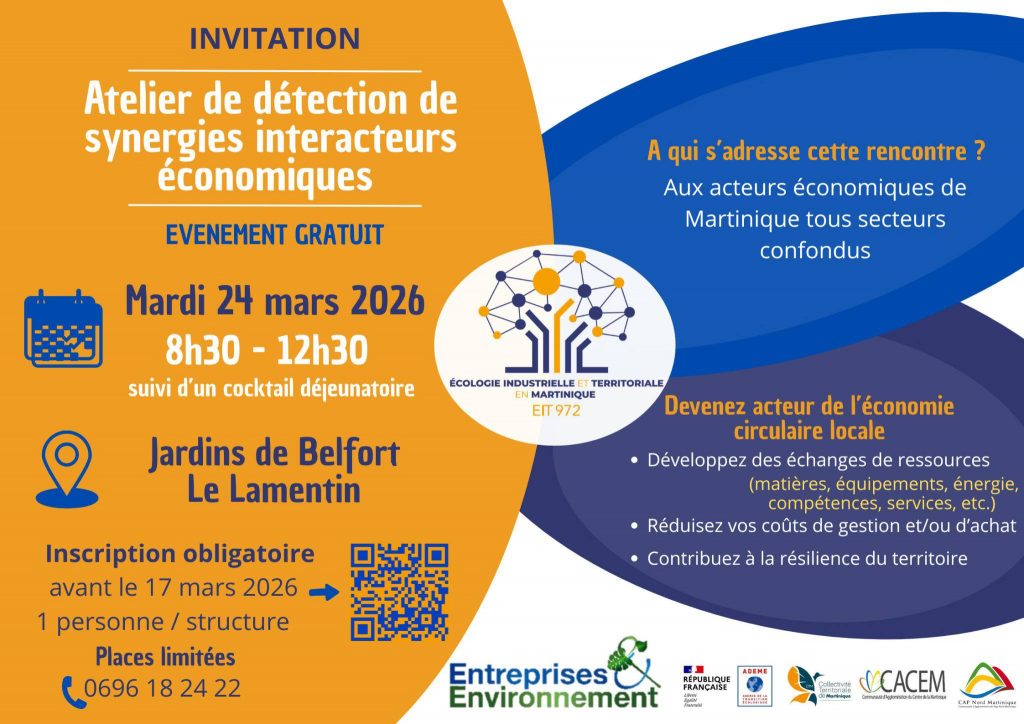

Une initiative pour les acteurs économiques du territoire. Une nouvelle rencontre est organisée le 24 mars 2026 afin de trouver des synergies entre les entreprises martiniquaises. Parmi l’ensemble des secteurs d’activité, la CRESS Martinique entend porter la voix de l’économie circulaire, locale et sociale.
Atelier synergies
Un atelier de détection des synergies est co-organisé par la CRESS Martinique le mardi 24 mars 2026, de 8h30 à 12h30 au jardin de Belfort, au Lamentin. L’événement sera suivi d’un cocktail déjeunatoire.
Par cette initiative, l’objectif principal des organisateurs est de :
« créer des coopérations concrètes entre structures du territoire », par le biais de « mutualisation de ressources, de partage d’équipements ou de compétences et de valorisation de matériaux ou services »,
indiquent-ils.
Les questions économiques étant essentielles pour la pérennité du territoire, l’événement est soutenu par les collectivités locales : Collectivité territoriale de Martinique, CACEM, Cap nord Martinique mais également par l’association Entreprises & Environnement ainsi que par l’ADEME.
Créer des synergies, au service du territoire
L’événement est ouvert à tous les acteurs économiques de Martinique, sans distinction de secteur d’activité.
« Une opportunité pour les structures de développer des coopérations locales et contribuer à l’économie circulaire du territoire »,
rappellent les organisateurs.
Lors de cette matinée, la CRESS de la Martinique participera à animer les échanges. Son implication vise à mieux faire connaître les principes de l’économie circulaire et locale, avec des retombées très concrètes pour les entreprises. Concrètement, il s’agit d’une opportunité de :
- développer des échanges de ressources
- réduire les coûts de gestion et/ou d’achat
- contribuer à la résilience du territoire
Pour participer, l’inscription est demandée par les organisateurs : here. Le nombre de places est limité, une seule personne est acceptée par structure. La date limite pour s’inscrire est fixée au 17 mars.