This important working session signals that the issue of Sargassum is being taken seriously in our territories and throughout the Caribbean.
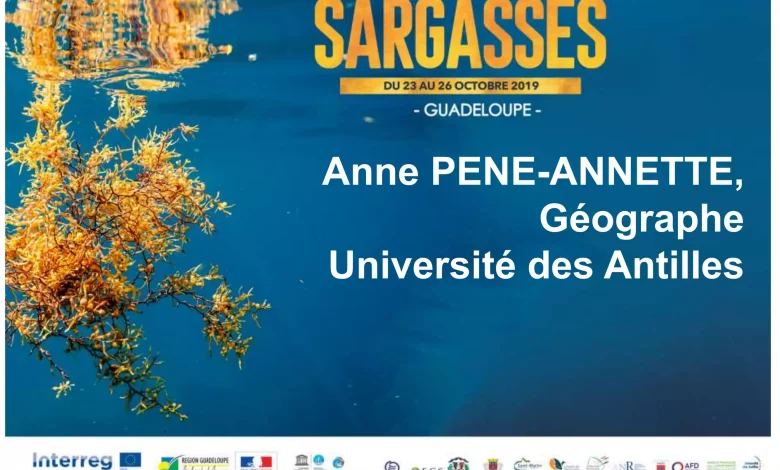
This ConferenceThis international conference, intended to be a major event, aims to establish a network of Caribbean and, more broadly, international scientific experts on the issue of Sargassum in the Caribbean. This network will help to foster
– strategies to be implemented at the watershed level,
– the effective tools that need to be developed to manage this chronic crisis and
– the levers to be utilized
to bring this issue to the attention of the highest international authorities.
Louis Boutrin

on the scale of an ocean basin
On February 5, 2019, Prime Minister Édouard PHILIPPE met with Dominique THÉOPHILE, Senator from Guadeloupe, in the presence of François de RUGY, Minister of State and Minister for Ecological and Solidarity Transition, and a representative of Annick GIRARDIN, Minister for Overseas Territories, Dominique THÉOPHILE, Senator from Guadeloupe, to discuss efforts to combat Sargassum seaweed in the Caribbean states and countries neighboring French Guiana, as well as the status of cooperation initiatives in this area. On July 17, 2018, the Prime Minister had entrusted Senator Dominique THÉOPHILE with a mission to this end as part of the national plan to prevent and combat Sargassum.
The report confirmed the scale of the phenomenon, which affects all coastlines to varying degrees, from French Guiana to the Yucatán. It describes the public policies and private initiatives implemented in the region’s states. It proposes potential areas for regional cooperation in both basic research and the development of innovative tools to predict strandings, organize cleanup efforts, and find ways to make use of Sargassum seaweed.
Senator Dominique THÉOPHILE advocates holding a conference in Guadeloupe to share progress in research and the implementation of plans to combat Sargassum, as well as promising initiatives in the prevention, management, and utilization of the algae. He also emphasizes the need to establish an international Sargassum observatory to build a network of stakeholders in the fight against this scourge, which affects the entire Caribbean.
The Prime Minister praised the scope and quality of the work carried out and confirmed that a conference would be held in Guadeloupe in late 2019. This conference will bring together the other countries affected by Sargassum blooms as well as regional cooperation bodies. France will propose addressing the issues posed by Sargassum seaweed within the appropriate diplomatic forums, notably through the creation of a dedicated working group under the Cartagena Convention, which could be established at the next Conference of the Parties.
The Prime Minister also indicated that a call for projects led by the National Research Agency (ANR), which involves numerous national and international partners, will be launched within the next fifteen days. This will help accelerate research into the causes of this proliferation, as well as the identification of solutions for predicting strandings and utilizing algae. The organization of a scientific meeting focused on the selected projects will be closely coordinated with the international conference.
As sustained washups of Sargassum have been observed in the Caribbean over the past few days, the Prime Minister took this opportunity to provide an update on the implementation of the national plan to combat Sargassum.
The national plan outlines the government’s support measures for local authorities as well as the conduct of operations. Currently, 14 vehicles are on permanent standby in Guadeloupe, and 12 in Martinique.
In addition, a network of 30 permanent sensors has been set up in Guadeloupe and Martinique to detect gas emissions caused by the decomposition of beached algae. The results of these measurements, along with public health advisories, are posted weekly on the websites of the regional health agencies.
To meet the goal of removing Sargassum within 48 hours, surveillance and detection capabilities have been strengthened: In December 2018, Météo-France was tasked with coordinating and developing a prototype for an operational system to forecast Sargassum strandings, with the test phase scheduled to begin in March 2019.
ADEME issued an initial report in late November 2018 on the evaluation of seaweed collection methods. It lists the recommended collection methods based on the configuration of the coastline and the intensity of seaweed stranding. It also confirms that only collections made in nearshore waters and from the shore—not on the high seas—can be considered. These recommendations will help guide local response efforts.