Although Sargassum seaweed plays an important role in the environment, it can have a number of harmful effects when it becomes too abundant. The following information lists the main ecosystems affected and the potential impacts on their environments.
Corals and Seagrass Beds
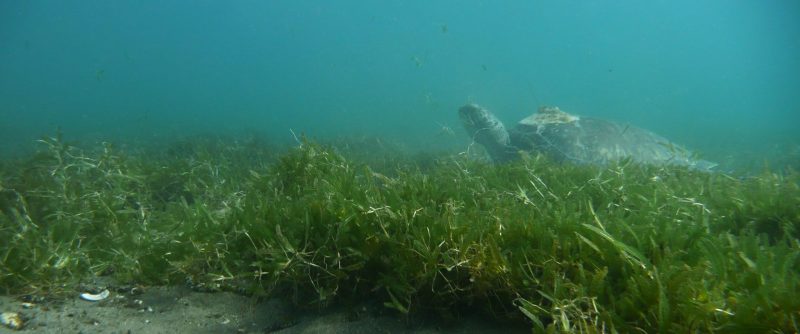
When Sargassum seaweed arrives in large quantities, it accumulates in layers near the coast, leading to a loss of available light for the corals and seagrass beds in the area (3). This loss of light reduces photosynthesis—which is essential to their survival—and contributes to coral bleaching. At the same time, invertebrate species living in coral reefs and seagrass beds—such as sea urchins and crabs—will suffocate and eventually die (4). If the algae are removed, it is highly likely that the seagrass beds will recover, but the consequences for the invertebrates will be more difficult to reverse (5).
Mangroves
The negative impacts of Sargassum accumulation in mangroves stem from deteriorating water quality, including oxygen depletion, a significant increase in organic matter, and the presence of sulfates (5).
Overall, the plant and animal species that make up the mangroves—except in extreme cases of accumulation leading to complete silting—will not be directly affected by the presence of these algae. It is likely that this resistance stems from the ability of mangrove plant species to utilize organic matter and rainwater flowing in from the watershed, which flushes the Sargassum out of the area (5).
Aquatic Fauna
The deterioration in water quality—particularly the loss of oxygen (2)—caused by the massive presence of Sargassum and its decomposition affects fish living along the coast and can even lead to their death (3).
The layering of algae restricts the free movement of fish and increases water turbidity (2).
Sea Turtles
Sargassum algal blooms found in the nesting areas of sea turtles—a protected species (1)—disrupt the females’ ascent onto the beach to lay their eggs (4) and interfere with the hatching of the hatchlings (3) as well as their journey to the ocean (4).

Consequences of mechanical harvesting
It should not be overlooked that the methods used to remove Sargassum, such as mechanical means, also have a negative impact on coastal ecosystems (5). In fact, the transportation of machinery and the collection of seaweed on beaches cause shoreline erosion and destroy turtle nests (2).
Mariska Desmarquis
References
1- ADEME, 2015. Collection and Utilization of Sargassum Seaweed in Martinique: Call for Expressions of Interest [Online PDF]: https://martinique.ademe.fr/sites/default/files/files/Accueil/ami-collecte-valorisation-algues-sargasses.pdf Page accessed on March 27, 2018.
2-French Agency for Food, Environmental and Occupational Health & Safety (ANSES), 2017. Exposure to fumes from decomposing Sargassum seaweed in the French West Indies and French Guiana. [Online PDF]: https://www.anses.fr/fr/system/files/AIR2015SA0225Ra.pdf Page accessed on March 27, 2018.
3- DEAL Guadeloupe 2014, Sargassum Report [Online PDF]: http://www.ifrecor.com/documents/2014-note-sargasses-fmazeas-deal-unite-biodiversite-marine-maj-5fev2015.pdf Page accessed on March 27, 2018.
4- DEAL Guadeloupe, 2015. Sargassum: Questions and Answers [Online PDF]: http://www.guadeloupe.developpement-durable.gouv.fr/IMG/pdf/Note_Sargasses__competences_DEAL_Direction_19_Juin2015.pdf Page accessed on March 27, 2018.
5- FLORENNE, T. and et al., 2016. The Phenomenon of Sargassum Drift in the Caribbean and French Guiana. French Government. [Online PDF]: http://cgedd.documentation.developpement-durable.gouv.fr/documents/cgedd/010345-01_rapport.pdf Page accessed on March 27, 2018.