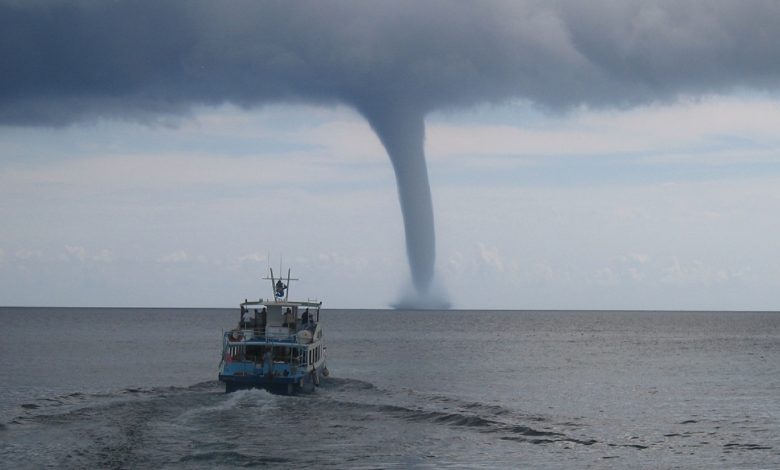
Tornadoes (or «water spouts» if they form over water)—vortexes of unprecedented violence—are considered the most dangerous weather phenomena on the planet. While atmospheric phenomena (low-pressure systems, tropical storms, hurricanes) are closely monitored at this time of year, predicting the occurrence of a tornado is extremely difficult. In fact, in addition to the complexity of their formation mechanisms, their erratic movement and very short lifespan make forecasting them virtually impossible. In the case of tornadoes, meteorologists’ analyses are therefore much more akin to predictions than to forecasts.
All of these factors explain why, when a tornado strikes, people never have time to react appropriately and can only endure the phenomenon. Destroying everything in its path, this natural hazard is feared around the world, particularly in the U.S. states of Texas, Kansas, Arkansas, Oklahoma, and Nebraska.
A unique training approach
While the Caribbean experiences numerous weather events each year (tropical waves, tropical depressions and storms, hurricanes, etc.), the probability of a tornado affecting the region is virtually zero; this is due to the way tornadoes form. In fact, three main conditions must be met simultaneously: very high temperatures (generally above 40 degrees Celsius), the presence of vast flat areas (overheated plains stretching for several hundred kilometers), and an influx of cold air from high-altitude areas (such as a mountain or a high plateau). As the cold air moves across the ground, it pushes the warm air upward; the warm air then cools, condenses, and forms thunderstorm cells beneath which tornadoes can potentially form if the warm, rising winds encounter wind shear. These are winds moving in opposite directions that can create the swirling motion so characteristic of tornadoes.
These very specific weather conditions occur only on the mainland; this explains why the Caribbean islands are spared from this hazard.
 The « Tornado Alley »
While most countries on the continent are potentially susceptible to tornadoes, the United States records the highest number of tornadoes each year. There is even a region called « Tornado Alley » (literally: the tornado corridor), where 700 to 1,200 tornadoes occur each year.
In the United States, tornado season begins in the spring; May is generally the month with the highest number of tornadoes, but the population remains at risk from this hazard until the end of September.
To estimate the wind speeds of a tornado, experts use the scale of Fujita ; developed in the early 1970s, this scale has 6 classes: from F0 to F5 (with class F5 measuring winds exceeding 320 km/h). Since tornadoes have been growing in intensity, this scale has been revised and now includes 13 classes (from F0 to F12), with the highest class (F12) measuring winds exceeding 780 km/h. Although such speeds seem unreal, sensors placed inside tornadoes have already measured gusts exceeding 750 km/h.
Inequality in the Face of Danger
Knowing how to respond to a tornado is vital for the people who are caught in one.
Just like with hurricane warnings, there are safety guidelines to follow in the event of a tornado; for example, open the doors and windows of your home to prevent pressure buildup and thus limit the risk of the building collapsing inward, stay away from openings (doors and windows), go down to the basement (if you have one) and curl up in a fetal position on the floor, taking care to cover yourself with a thick or fleece blanket; lie down in a bathtub and cover yourself with a comforter, etc.
There are also building codes, and the construction of tornado shelters (which are generally underground) is recommended. Unfortunately, due to their cost, only the wealthiest residents can afford them, which highlights a glaring inequality in the face of danger…
Since the climate is expected to change over the next 80 years, we need to remain vigilant, as phenomena that do not directly concern us today could potentially become much more familiar to us in a few years. Stay tuned…