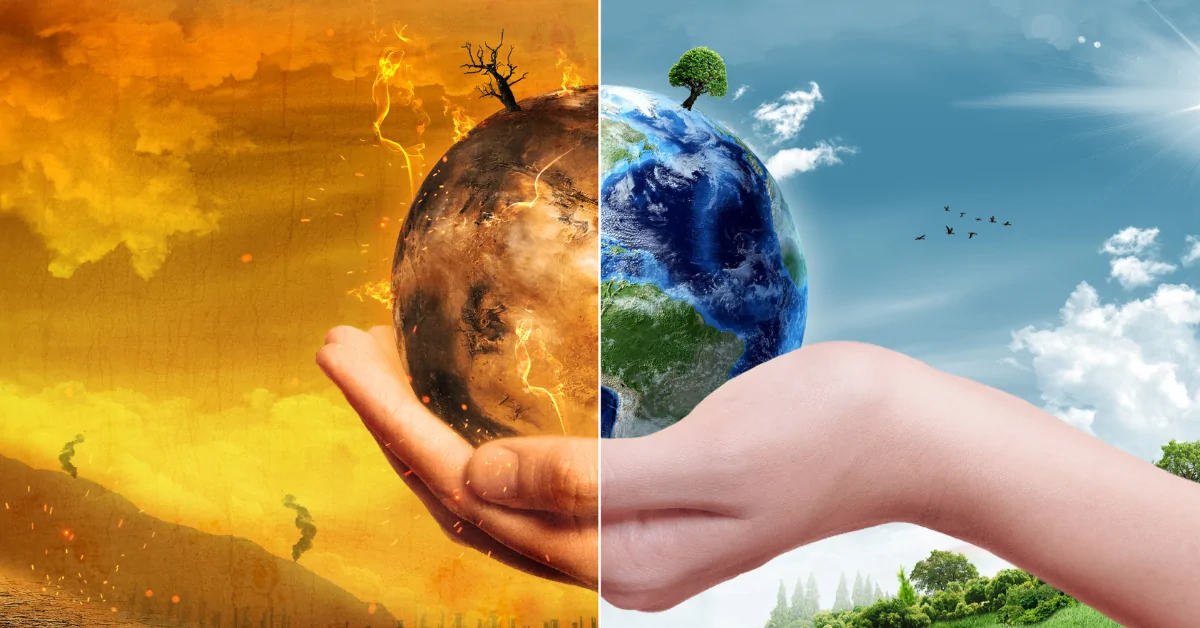
Climate change is a long-term change in the physical parameters of the Earth’s climate, and more specifically, in the various regional climates. These changes result from mechanisms intrinsic to the Earth, external influences, and human impacts.
Since its inception, the Earth has undergone numerous climate cycles: ice ages have alternated with much warmer periods, known as wet periods at low latitudes. While these dynamics have entirely natural causes, human activity—particularly industrial activity—appears to be responsible for contemporary global warming. This is primarily the result of greenhouse gas emissions (CO2, methane, fluorinated gases, etc.) into the atmosphere.
The Main Causes of Climate Change
De façon générale, le changement climatique désigne l’ensemble des modifications des caractéristiques climatiques à un moment donné et en un lieu donné, que cela se traduise par un réchauffement ou un refroidissement global de la planète.
Natural factors external to the climate system—such as increased volcanic activity, changes in the Earth’s axial tilt, an increase in the Earth’s orbital ellipse around the Sun, and polar flattening (polar precession)…have been identified as potential factors that cyclically alter (over tens of thousands of years) the established climate.
Climate change can also result from human activity; this is the case, for example, with the excessive consumption of fossil fuels (coal, natural gas, oil), as well as firewood, which release large volumes of greenhouse gases (carbon dioxide, methane, nitrous oxide, etc.) which, by accumulating in the lower layers of the atmosphere (the troposphere) like a blanket, trap the infrared radiation emitted daily by the Earth and thus keep the Earth’s temperature higher than usual. Deforestation also contributes to this phenomenon, since trees no longer absorb CO2, which contributes to the greenhouse effect (the abnormal accumulation of heat in the lower layers of the atmosphere). Between 1860 (the start of the First Industrial Revolution) and 2010, the concentration of pollutants in the atmosphere rose from 280 ppm (parts per million) to just over 400 ppm, thereby significantly intensifying the greenhouse effect.

The Consequences of Climate Change
Si dans son premier rapport, le GIEC (Groupement Intergouvernemental sur l’Evolution du Climat) estimait probable à 55 % environ le rôle de l’homme dans le réchauffement climatique, dans son dernier rapport (2014), cette probabilité s’élève désormais à 95 %.
The best-known and most noticeable effects of climate change are: the melting of high-mountain glaciers and ice caps, rising average sea levels, coastal flooding, population displacement (now referred to as “climate refugees”), desertification, ocean acidification, and the spread of certain diseases that were previously confined to specific regions.
For example, it is estimated that if nothing is done to reverse the trend, by 2100 the global average temperature is expected to rise by +1.6 to +5.4 degrees Celsius. It is worth noting that between 1900 and 2000, the global average temperature rose by +0.85 degrees Celsius. Similarly, the average sea level has risen by more than 25 cm over the past 100 years.
Les chercheurs estiment aussi qu’à long terme, le changement climatique induira des perturbations au sein du cycle de l’eau, des difficultés agricoles, l’apparition de processus de désertification, la disparition de certains espaces et/ou habitats côtiers, comme les deltas, les mangroves, les récifs coralliens, une recrudescence du paludisme, l’extension des maladies infectieuses comme le choléra, et plus généralement une accélération de la perte de biodiversité.
En définitive, ce qui change aujourd’hui par rapport aux variations climatiques qui ont pu être observées par le passé, c’est que la vitesse moyenne du réchauffement des basses couches de l’atmosphère est élevée et semble s’accentuer, sans que rien ni personne ne puisse l’arrêter.
Il importe donc dès aujourd’hui de mettre en œuvre des mesures d’adaptation et d’atténuation face à ce phénomène. La COP 21 (21th The Conference of the Parties, to be held in Paris at the end of the year, is expected to play this role…
There's a lot of talk about the greenhouse effect—what is it?
L’effet de serre est un phénomène naturel qui maintient la vie sur terre. En effet, plusieurs gaz dits « gaz à effet de serre » forment un couvercle autour du globe retenant ainsi la chaleur émise par le soleil, absorbée par la terre, puis renvoyée par cette dernière vers l’atmosphère.
L’effet de serre naturel conditionne donc nos climats et nos écosystèmes. Un grand nombre de ces gaz sont naturellement présents dans l’atmosphère, mais l’activité anthropique accroît désormais la concentration de certains d’entre eux, ce qui sous-tend la formation d’un effet de serre additionnel (généré par l’activité anthropique).
Les gaz à effet de serre sont divers : dioxyde de carbone, méthane, chlorofluorocarbures, ozone, etc. Le dioxyde de carbone est le gaz à effet de serre le plus produit par les activités humaines, on estime que sa concentration dans l’atmosphère a augmenté de 31 % depuis 1750.
These emissions are primarily caused by the combustion of coal, oil, and natural gas. Deforestation and the expansion of livestock farming are also significant sources of emissions, as trees normally help regulate the climate by absorbing carbon dioxide (CO2) de l’atmosphère. Aussi, lorsqu’ils sont abattus, cet effet positif est perdu et le carbone stocké dans les arbres est alors libéré dans l’atmosphère, aggravant ainsi l’effet de serre. Bovins et ovins produisent aussi de gros volumes de méthane qu’ils libèrent dans l’atmosphère lors de leur processus de digestion.
This increase in the greenhouse effect caused by human activity is a cause for concern, as emissions of these gases have the potential to warm the planet to levels never before reached. Such changes could have environmental, economic, and social repercussions that are completely unpredictable—and perhaps even irreversible…
Lancer MONPELAT, Pascal SAFFACHE