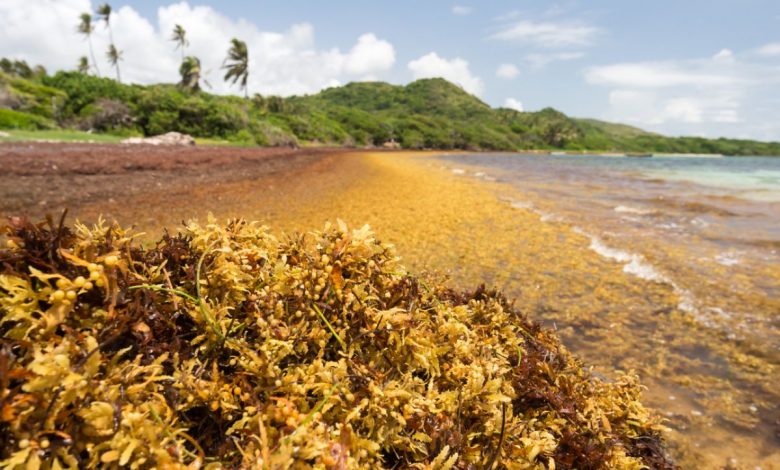
Sargassum has now become a common sight along the coastline of many communities in Martinique. But according to a report published in January 2026 by the CEROM partnership—comprising IEDOM, INSEE, and the French Development Agency (AFD)—the phenomenon could be entering a new phase. While seaweed strandings were historically concentrated in just a few months of the year, recent observations raise concerns that brown algae will become increasingly common throughout the year.
Algae That Have Changed in Size in the Atlantic
Sargassum is a type of floating brown macroalgae that naturally drifts in the Atlantic Ocean. Long concentrated in the Sargasso Sea, off the coast of Florida, they now form a vast belt of seaweed stretching between Africa, South America, and the Caribbean.
Scientists are still trying to understand exactly what is causing this bloom, which has been observed since the early 2010s. However, several factors appear to play a role: increased nutrient inputs, particularly from the Amazon and the Gulf of Guinea; changes in ocean currents; and warming waters. Sargassum thrives particularly well at temperatures between 28 and 31 °C.
Since 2011, strandings have become a recurring occurrence throughout the Caribbean, transforming what was once an isolated phenomenon into an ongoing problem for coastal areas.
The year 2025 was marked by exceptional harvests
According to Météo-France, 2025 ranks as the third-largest year since satellite monitoring of Sargassum began in 2011.
May 2025 even set a record in the Atlantic, with an estimated biomass of 37.5 million metric tons.
Beyond these impressive volumes, observers have noted significant strandings during unusual times of the year. Several incidents occurred while the protective devices were undergoing maintenance, a situation that illustrates how the phenomenon is evolving.
When Sargassum No Longer Follows the Seasons
This is undoubtedly one of the key takeaways from the CEROM report.
For several years, strandings occurred mainly between March and September. This seasonal pattern allowed local governments, residents, and coastal professionals to anticipate the most critical periods.
Today, this pattern seems to be gradually fading. Events occurring outside the usual period are becoming more frequent and more significant. The authors of the report mention a possible «seasonal adjustment» of the phenomenon. In practical terms, this means that shipments could arrive at any time of the year.
This development greatly complicates efforts to combat Sargassum. Equipment, monitoring systems, and collection operations must remain available for much longer periods than before.
Martinique is one of the hardest-hit territories in the French West Indies.
According to the data presented in the report, approximately 70 kilometers of coastline—or 16 % of Martinique’s coastline—are regularly affected by strandings. Nine municipalities are repeatedly affected, and ten others experience such incidents more occasionally.
The most vulnerable areas are located primarily along the Atlantic coast, as well as in certain sections of the southern coastline. In total, 78 sites have been identified as posing a health risk, more than half of which are classified as having a high to major health risk.
This particular situation explains why Martinique is often at the forefront when it comes to testing new collection systems or adapting strategies to manage the issue.
Consequences that go beyond mere visual nuisance
When Sargassum accumulates on beaches and in coves, it quickly begins to decompose. This decomposition produces, among other things, hydrogen sulfide (H₂S) and ammonia (NH₃), two gases that can affect the quality of life for exposed populations.
A study conducted in Martinique identified approximately 700 patients who experienced health effects related to exposure to Sargassum emissions between 2018 and 2025. In particular, the researchers recommend continuing studies focusing on children, pregnant women, the elderly, and the most vulnerable populations.
The consequences are also being felt in the day-to-day operations of schools. In recent years, several elementary and middle schools have had to adjust their operations or temporarily relocate students due to strandings and the associated odors.
A challenge that could become a long-term issue
The CEROM report shows that Sargassum is no longer merely a seasonal or exceptional phenomenon. Its more frequent occurrence, its prolonged duration, and the uncertainties surrounding its future trends now raise questions about the regions’ ability to adapt over the long term.
For Martinique, the challenge is no longer simply a matter of managing strandings when they occur. It is also a matter of preparing to live with a phenomenon that could become permanent—or at least much less predictable than before.