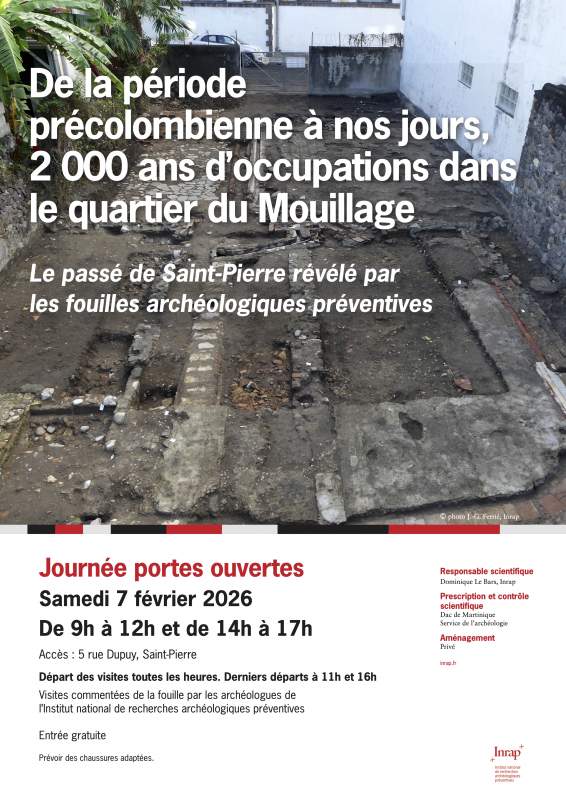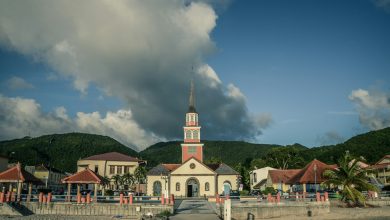
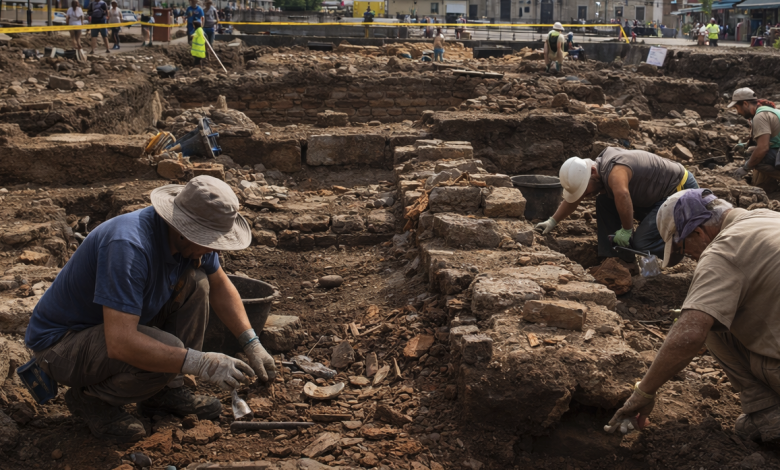

What if a single street could take you back in time nearly two millennia? Since December 2025, an archaeological excavation conducted in Saint-Pierre on Rue Dupuy has revealed an exceptional stratification of the city’s history: from traces of ancient Native American settlements to the remains of the Mouillage district, as it took shape and evolved between the 17th century and the disaster of 1902. Covering approximately 300 m², this excavation site sheds light on the evolution of an iconic area located in the immediate vicinity of the cathedral, where religious life, urban development, housing, and port-related activities intertwined.
Beyond its scientific value, this project also offers the general public a rare opportunity: visit an ongoing archaeological excavation site, meet the archaeologists and get a “real-life” understanding of how the past is reconstructed, layer by layer.
A tour open to everyone; free admission
The archaeological excavation site located 5 Dupuy Street in Saint-Pierre will be open to the public on a special day:
Saturday, February 7, 2026
🕘 9 a.m. – 12 p.m. and 🕑 2:00 p.m. – 5:00 p.m.
(last tours at 11 a.m. and 4 p.m.)
✅ For all ages – free admission
📌 Bring appropriate shoes
A simple, free, and valuable invitation: come see how history resurfaces beneath the foundations of a neighborhood that experienced the golden age of Saint-Pierre… and then its sudden collapse.
A neighborhood that grew up alongside the Dominicans, shaped by the port
The unearthed remains tell, first and foremost, the story of the Mouillage neighborhood, which began to take root in the second half of the 17th century with the arrival of the Dominican Order. This settlement was accompanied by the creation of a parish church and its cemetery, gradually establishing the organizational framework for this sector.
In the 18th century, the neighborhood experienced rapid growth and became more densely populated, driven by the boom in port activity and trade. Then, in the 19th century, urban development continued until the city was destroyed in 1902.
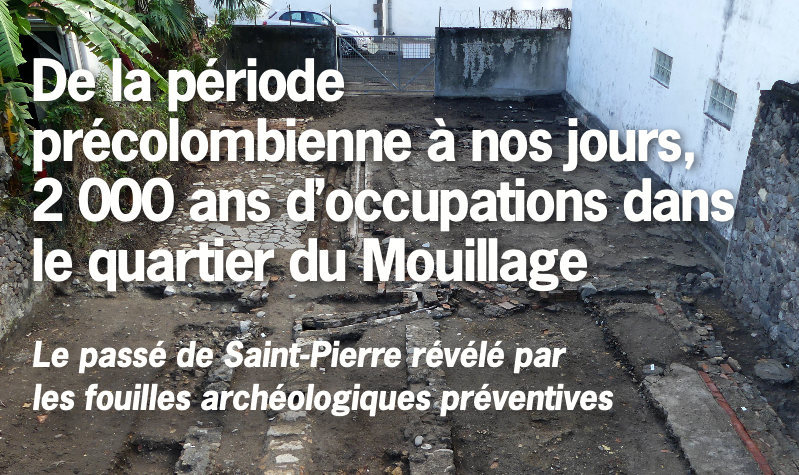
On the excavated site, archaeologists have uncovered numerous artifacts that bear witness to these stages: walls, floors, pools, but also a water management system with water supply and drainage pipes. These traces reveal, in particular, a 19th-century bourgeois residence, organized, laid out, and connected to infrastructure that speaks volumes about the comfort and daily life of the time.
Successive reconstructions, possibly linked to natural disasters
Another notable finding: beneath these ruins, excavations show a series of renovations and reconstructions. Some of these may be linked to major natural events—such as earthquakes, cyclones, or other disturbances—that may have led to repairs, adaptations, or alterations to the buildings.
This type of archaeological analysis provides a better understanding of how a city lived, endured, and rebuilt itself… before being completely destroyed in 1902.
A much older Native American presence beneath the historic city
But one of the most remarkable discoveries at the site lies even deeper: a Native American settlement below historical levels.
Archaeologists have identified a stratum there containing a wealth of artifacts: ceramics, stone artifacts, and other material remains, located between two deposits associated with eruptions of Mount Pelée dating from 60 B.C. and A.D. 1,300..
This data adds to our understanding of Saint-Pierre’s pre-Columbian past and serves as a reminder of a fundamental reality: before the colonial city, before the Mouillage neighborhood, before the walls and streets… This territory was already inhabited, lived in, and organized.
A project led by INRAP, under the direction of the government
This archaeological excavation is being conducted by the’National Institute for Preventive Archaeological Research (Inrap), as mandated by the government (DAC of Martinique), prior to a private development project. The project is taking place between December 2025 and March 2026, with scientific oversight and a clear mission: to document, analyze, and share.
INRAP, a public institution under the supervision of the Ministries of Culture and Research, is involved in the early stages of many development projects to identify and study archaeological heritage. Every year, its teams carry out thousands of projects in France and its overseas territories, with a focus on research… but also on sharing knowledge with the public.
The principal investigator for this excavation is Dominique Le Bars (Inrap).
See archaeology in action, right in the heart of Saint-Pierre
This event on Saturday, February 7, 2026 It’s not just a tour: it’s a way to rediscover Saint-Pierre in a new light—through its foundations, its traces, its breaks, and its continuity. A rare opportunity to understand that the city’s history does not begin in the 17th century, nor does it end in 1902, but is rooted in a much deeper past.
Above all, it’s a simple invitation: Come on by—admission is free, and watch as the story comes to light.