 The government is taking emergency measures in response to the scale of the problem
On Friday, May 4, Franck Robine, the prefect of the Antilles Defense Zone and prefect of Martinique, presented a 20-point emergency response plan to address the Sargassum crisis, which continues to worsen. Satellite observations have shown that another massive influx of brown algae is expected to reach our shores in the coming days. The prefect has set a goal of collecting the algae within 48 hours of it washing ashore—the only measure currently capable of limiting the impacts on the environment and public health.
It was in the prefecture’s Sargassum Operations Center that the prefect had invited officials and leaders from various state and territorial agencies to present the new emergency plan to combat Sargassum. «Comprehensive, large-scale measures for long-term action» that are to be implemented in a coordinated manner by all agencies: municipal governments, the military (RSMA), Fire Department, Civil Protection, and the Regional Health Agency—with the support of public service workers and increased resources, as the government is allocating a new fund of 3 million euros for the purchase of suitable collection equipment and protective gear….A Civil Security Assistance Mission (MASC) is being dispatched to the Antilles to support cleanup efforts.
The prefect advocates for proactive planning and a rapid response, and sets a target of intervening within a maximum of 48 hours after strandings…
To this end, a new organizational structure is being put in place with the appointment of a national coordinator tasked with drafting a plan to combat the phenomenon, which will be implemented in each region as a «local Sargassum emergency plan» (PULSAR), and with overseeing all relevant ministries. The prefect in charge of implementing and coordinating this plan with the prefects of French Guiana and Guadeloupe aims to «respond quickly and effectively.» He has made numerous field visits and has observed the variety of stranding sites, each of which requires a specific approach. Twenty-four sites of massive strandings have been identified, some of which are difficult for heavy machinery to access. The prefect advocates for tailored interventions—«we have to take a nuanced approach,» he said—meaning practically on a case-by-case basis, and to that end, he is counting on the support of mayors and residents. He spoke of a «kind of contract» between the mayors and the government; joint meetings are becoming more frequent these days to ensure a more coordinated and better-suited response.
This increase in the number of operations must be supported by an enhanced ability to anticipate developments and, consequently, to gather intelligence. Satellite monitoring has been stepped up, as has aerial surveillance, with the participation of civil defense and customs helicopters. Here, too, the goal is to move more quickly to prepare for the removal of the Sargassum. This is because the main problem lies in the decomposition of the seaweed washed up on the coastline, as it releases hydrogen sulfide (H₂S)—a neurotoxic gas that affects both the affected population and ecosystems.
«To be able to remove Sargassum from a beach within 24 or 48 hours, so that it can be collected before the algae decompose and produce hydrogen sulfide»
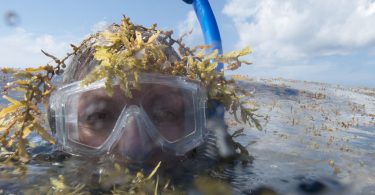
This goal, announced by the government, comes in response to numerous complaints and petitions from affected residents, who so far feel as though they have been left to fend for themselves. The prefect stated «These measures address a very strong sense of concern among the public.». The phenomenon, which began in 2011 and peaked in 2017, has now been ongoing without interruption since last December, affecting most of the islands in the Caribbean and having a significant impact on public health and the tourism industry. And based on current knowledge, the phenomenon does not appear to be abating.
The prefect announced a series of measures aimed at better understanding the causes of this phenomenon and finding solutions. As part of this effort, ADEME is launching a new call for projects, with a budget of 1 million euros, for the collection and recycling of seaweed. Various research institutes should continue their investigations, particularly into recycling processes, such as the composting systems already in place in Martinique. Research is also underway on at-sea collection. And an international conference is expected to address the root causes of this scourge. There is, in fact, strong evidence pointing to the impact of various African and Brazilian rivers laden with organic matter (fertilizers, pesticides), which are believed to have nourished the Sargassum and contributed to its proliferation in the southern Caribbean.
For now, Madinin’Air, the Regional Health Agency, and sentinel physicians are responsible for measuring H₂S levels and monitoring the impact of this gas on the health of local residents. The prefect stated, «We are aware of our responsibilities toward the local communities.» At this time, the current state of research does not allow us to determine the impact of chronic exposure to H2S gas, the main cause for concern among local residents who have been exposed to it almost continuously for the past six months. Another pressing issue for the authorities is the declaration of a state of natural disaster, which the government is reluctant to issue—likely because the phenomenon has become so common—even though residents are calling for it. The material consequences of exposure to this gas are enormous, and local residents are spending thousands of euros to replace their electrical and electronic equipment and to clean their homes, which have been damaged by corrosion. In this regard, the prefect announced a meetingAgreement reached at the Ministry of Finance (Bercy) between the Ministry of Finance and the insurance companies.
«Everything points to the fact that what is happening is a phenomenon of enormous magnitude!»
This warning issued by the prefect merely confirms what people living along the coast have known and endured for several months now. Will they be reassured by the authorities’ stated intention to take massive action now in the face of the health threat posed by this scourge? The prefect concluded «There will be an escalation in the interventions. I’m setting May as my target date, given what the local residents are going through.».
Nathalie Laulé