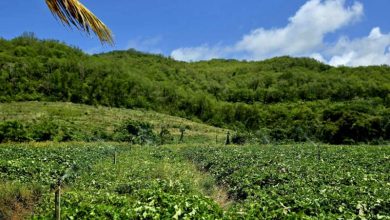

The story of the Macabou Gardens is the story of the regeneration of land depleted by decades of intensive livestock farming. On this land, Céline sought to help people reconnect with nature through a variety of activities, such as farming, volunteering, and retreats. Located on a secluded plot of land, the Macabou Gardens offer a wonderful opportunity to reconnect with nature and serve as a fine example of a circular and social economy.
Moving Beyond Fantasies and Fears
Living close to nature has many benefits but can also be subject to many idealistic notions. «There are fantasies that it will be easy to grow vegetables, that we’ll be able to walk barefoot, and that all it takes is a little love for the plants to grow. »A lot of people arrive with fantasies like that,” points out Céline, who runs the Macabou Gardens.
For others, it’s a matter of «overcoming their fears about the agricultural sector, which can manifest as a fear of isolation, a fear of the hard physical labor, and a fear of a lack of intellectual stimulation,» she adds. Conversely,
«Living the farming life makes you realize that it’s not like that at all. It’s a very creative life with plenty of opportunities for imagination, creativity, and social interaction.»
Agricultural Volunteering
The Macabou Gardens regularly welcome agricultural volunteers, particularly through the WWOOF program.
«Some people have been fortunate enough to pursue an education and grow up in a highly intellectual environment, but when they finish their studies—or even after an entire career—they end up feeling dependent, they feel clumsy because they never learned to acquire the practical skills that are essential to their lives and survival,»,
Céline describes us.
«Knowing how to build a shelter, how to plant a few plants, and how to identify plants that can be used for food and medicine are all skills that contribute to mental well-being.»
In the early years, the gardens in Macabou welcomed visitors they had met at the Vauclin market.
«This was an activity that was entirely geared toward a local audience—residents of the area—and over the course of the seven years that this program, called «Tour & Tasting,» ran, the goal was to raise environmental awareness.»
Humans in Nature

«Many people concerned with environmental issues view humans as a very negative aspect of nature,» explains Céline, “when in fact it’s more a matter of finding a necessary balance between the two.”.
«For the past three years, I have been hosting retreats in the gardens of Macabou, as well as welcoming anyone who wishes to organize workshops related to healing: water therapy, earth therapy, self-care, music therapy, or art therapy.»
Right now, Swedish painting is in the spotlight, as is flour painting, «which means you don’t have to use chemical paint,» adds Céline.
Humans are naturally connected to nature, but the divide between the two is essentially «intellectual»; Macabou’s gardens are representative of a type of place where effort and pain have been replaced by calm and pleasure, because living things are a «source of immense inspiration,» she concludes.
S.D.