Energy Transition: Roadmap from the National Debate Unveiled
15 major goals and 33 commitments: that is what the «Nantes, a Metropolis in Transition» roadmap—developed in collaboration with citizens—encompasses.
«The “We Are the Energy Transition” Grand Debate, launched more than 18 months ago by the metropolitan area and its 24 municipalities, was a great democratic experiment and an unprecedented mobilization of citizens and local stakeholders,» said Johanna Rolland, president of Nantes Métropole.
«With 53,000 participants, 11,000 contributors, 270 different organizations involved, the organization of nearly 80 events across all municipalities in the region, and nearly 160 stakeholder reports, the initiative was a resounding success.», notes Fabrice Roussel, vice president of Nantes Métropole, in charge of citizen engagement.
The decision to entrust the leadership of the Great Debate to a commission composed of four citizens—with no elected officials—was also an unprecedented move, driven by a desire for transparency and independence. The 12 initiatives proposed in the final report  guided the discussions among the municipalities and the metropolitan area.
The Roadmap “Nantes, a Metropolis in Transition” sets forth a collective vision, from which 15 major goals and 33 commitments stem.


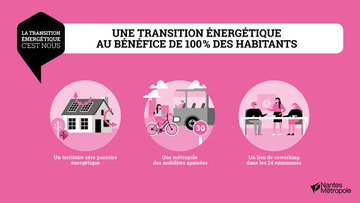

The 3 Unique Features of the «Nantes-Style» Energy Transition»
«The Great Debate highlighted the unique aspects of a “Nantes-style” transition—an energy transition that benefits everyone, one that fully harnesses local renewable resources and is fully citizen-led.», notes Julie Laernoes, vice president in charge of energy transition. .
An energy transition that benefits 100% residents, particularly in the areas of housing and transportation:
The goal? To make the metropolitan area a region with zero energy-inefficient buildings. How? By allocating 100 million euros from the metropolitan area’s budget by 2030 for social and private housing and public buildings. And by doubling the number of renovation projects to combat energy insecurity among low-income residents and reach 6,500 housing units by 2030.
Another measure: preparing the region for the mobility of the future and creating a metropolitan area with sustainable mobility. And reduce “solo” car use by 30 % by investing 1 billion euros by 2030 to support new modes of travel and develop a culture of intermodal transportation (public transit, biking, walking, carpooling, and car-sharing, etc.): new trams, e-busways, and the phase-out of diesel buses by 2020.
Harness 100 % of local renewable resources:
The goal is to make 100 % of rooftops usable to create the first “urban energy and green canopy” by 2030. By harnessing the full potential of building rooftops to generate renewable energy, grow crops, plant vegetation, and provide cooling… «and to present this urban canopy as a forest canopy—directly influenced by light and solar radiation and particularly rich in biodiversity», explains Julie Laernoës.
Another commitment: to aim for 50 % of local and renewable energy by 2050 by promoting all local energy sources in coordination with neighboring regions, with a focus on doubling solar power generation by 2020, particularly on the rooftops of commercial buildings in the metropolitan area, as well as projects involving tidal power, biogas, biomass, wind power, and marine energy.
An energy transition that is 100 % citizen-led and empowers residents:
The commitment is to create 100 “citizen labs” by connecting locations throughout the metropolitan area dedicated to the energy transition, in order to engage residents of all generations and make them the key drivers of the transition across the entire region by building on and expanding the challenges and communities identified during the Great Debate: “clever,” “pioneers,” “trailblazers,” and others.
And turn the metropolitan area’s 24 municipalities into testing grounds for accelerating the transition to a sustainable daily life: small-scale renewable energy production sites (for example, photovoltaic shade structures in the Zénith parking lot in Saint-Herblain), reduction in street lighting (by one-third by 2020), local and organic food for institutional dining services, and innovative urban projects (for example, Pirmil-les-Isles in Rezé, based on the circular economy),
development of urban farms, etc.
 http://www.calameo.com/read/004590458d29eeb7b698c
«These commitments are not just those of the metropolitan area and the municipalities. They reflect a collective effort and mark the starting point of a process to be shared with the region’s residents and all stakeholders: associations, businesses, community groups, chambers of commerce, unions, public and private organizations, etc.», explains Johanna Rolland.
Caroline Houalet, a member of the independent commission for the “Great Debate on Energy Transition,” emphasizes the citizen-led efforts that laid the groundwork for the roadmap underpinning the metropolitan area’s climate plan. She also highlights the central role played by discussions about lifestyles. «The commission’s role is, of course, over. But we have recommended that there be oversight—a right to monitor—the decisions made and the way this roadmap is implemented. The issue of governance is important. It cannot be solely centralized.»
Residents of Nantes are invited to join in the festivities marking the launch of this roadmap on Friday, February 16, at 6:00 p.m. at the Titan lounge, located at the Hangar à bananes on the Île de Nantes.
Support Nantes Métropole's transition!
By signing, I am committing today, alongside Nantes Métropole, to making Nantes a city in transition!
Source: https://www.nantes.fr/transitionenergetique