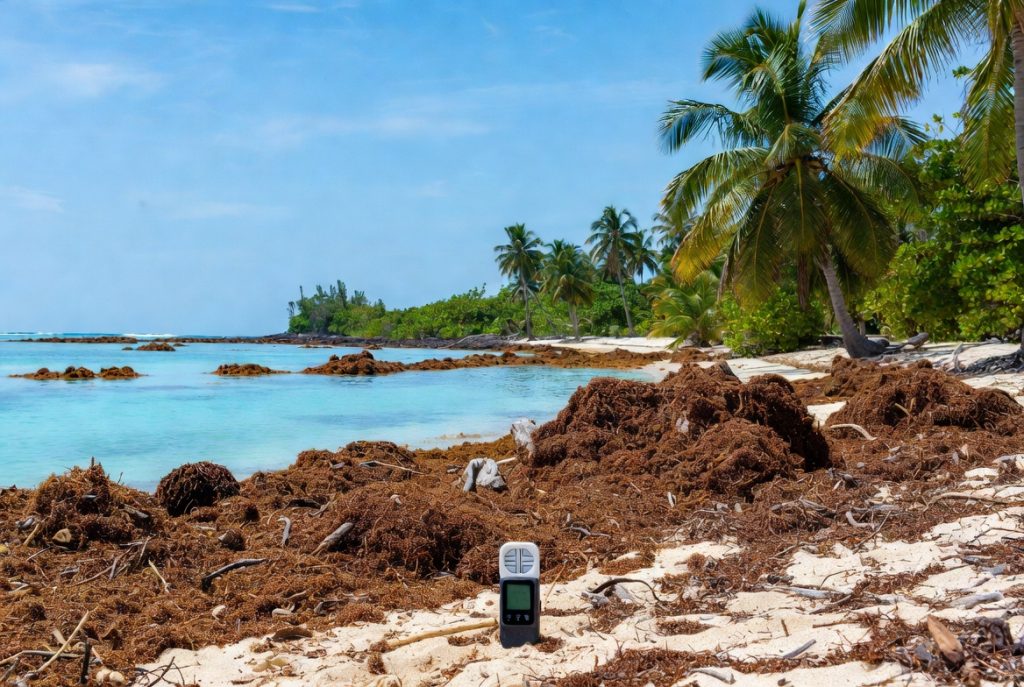
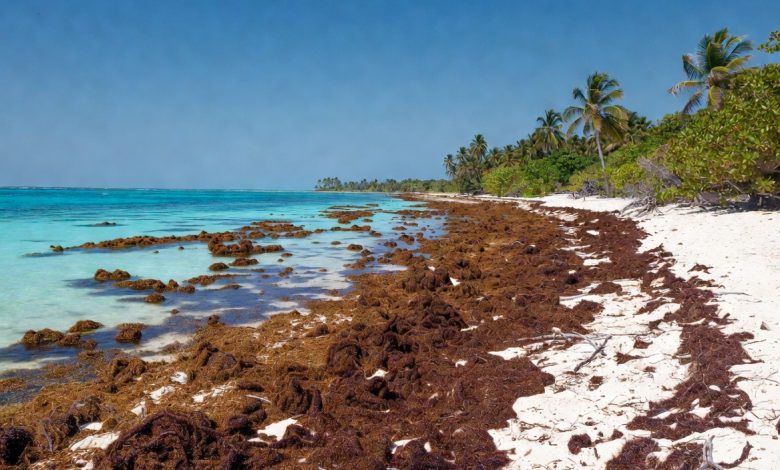
Despite all the studies that have been conducted, the consequences of Sargassum strandings in the Caribbean are still not well understood. That is why the authorities have launched the SAGES project: to better understand the long-term consequences of Sargassum strandings on human health and the environment in general.
Gaining a Better Understanding of the Consequences of Sargassum Washups in Martinique
The short-term effects of Sargassum decomposition on air quality are well known: it degrades air quality and can cause health problems, but what about repeated exposure? At this point, scientists lack information, which is why the project Sargassum, Analysis of Emitted Gases and Particles, and Health Impacts in the French West Indies (SAGES) was launched in late June in Martinique and is expected to run for four years.
The SAGES research program is led by IRSET-IRSEM, in partnership with Santé publique France, and was selected as the winner of the National Research Agency’s Sargassum III call for proposals.
Specifically, the SAGES project consists of three distinct components, according to an announcement by Madininair:
- «Better characterizing population exposure to gases and particles emitted by decomposing Sargassum (WP1)”
- To study the health effects, in particular through a study on the perceived health status of exposed populations (WP2)
- »Develop prevention measures to support public authorities and better protect the population (WP3)"
Air Quality
Madininair is responsible for coordinating the first phase of this project, namely all aspects related to exposure characterization. «While air quality monitoring stations have been tracking hydrogen sulfide (H₂S) and ammonia (NH₃) for over ten years, the SAGES project will go a step further by identifying all emitted gases and particles and improving exposure assessment through field measurements, atmospheric modeling, and environmental data,» Madininair stated in a press release.
This project brings together numerous stakeholders in the field of environmental health in Guadeloupe and Martinique. Scientists, policymakers, and research centers: all resources are being mobilized to try to better understand the challenges posed by the decomposition of Sargassum and its consequences for human and environmental health. Stay tuned for updates.