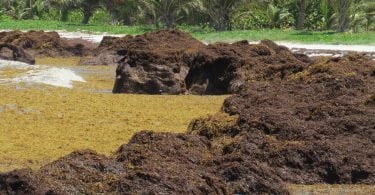
What is Sargassum? How does it function, reproduce, and feed? From birth to decomposition, this fact sheet summarizes some of the characteristics of this plant family.
Seaweed
Algae are aquatic plants that represent the first form of life to appear on Earth. There are a multitude of species, living in both fresh and saltwater, but they all perform photosynthesis because they contain chlorophyll. They belong to the group of thallophytes, meaning they have neither stems, leaves, nor roots, but rather a body called the thallus (5).
Sargassum seaweed
Unlike algae that attach themselves to a substrate, sargassum are brown algae (1) that live in the open ocean. They are therefore referred to as pelagic (2). Two species, Sargassum natans and Sargassum fluitans, are frequently found in the Caribbean (1).

Sargassum natans on the left and Sargassum fluitans on the right. Photo copyright by GCRL (Gulf Coast Research Laboratory) http://gcrl.usm.edu/sargassum/sargassum.identification.guide.php
Morphology of S. natans and S. fluitans
These two macroalgae look very similar. Their numerous small, serrated thalli (1) have branched stems containing several aerocytes—gas-filled floats that enable them to float (4). Ranging in size from 50 cm to 1 meter, these asymmetrical algae lack a main stem but form a cluster of «branches» (1).
Reproduction Method
S. fluitans and S. natans They multiply primarily through the fragmentation of their thallus (4), with each fragment subsequently able to grow and fragment again to form other thalli, and so on (1). The nutrient content of the water determines how quickly they grow (4). Their ability to absorb nutrients is much greater than that of terrestrial plants (1)
Chemical Composition
The Sargassum family consists of algae that are generally composed of 70 % to 90 % water. The dry matter consists of 10 % to 40 % of minerals. They have a high capacity to accumulate heavy metals (1).
Decomposition
Given their numerous branches extending in all directions, one might expect aerobic decomposition (in the presence of oxygen) of the Sargassum. However, when large amounts of Sargassum wash ashore and pile up, depriving it of oxygen, anaerobic decomposition (without oxygen) occurs, leading to the emission of gases, primarily hydrogen sulfide (H2S) (4). The H2S is colorless, has a density greater than that of air, and has a rotten-egg odor (1).
Mariska Desmarquis
References
1- French National Agency for Food, Environmental and Occupational Health & Safety (ANSES), 2017. Exposure to fumes from decomposing Sargassum seaweed in the French West Indies and French Guiana. [Online PDF]: https://www.anses.fr/fr/system/files/AIR2015SA0225Ra.pdf Page accessed on March 27, 2018.
2- Caribbean Hotel & Tourism Association, 2016. Sargassum: A Practical Guide for the Caribbean. Translated from English by Françoise Miranne-Parole and Nady Vial-Cabrera, Director of International Cooperation. DEAL Guadeloupe. [Online PDF]: http://www.guadeloupe.developpement-durable.gouv.fr/IMG/pdf/CAST_VF_pdf.pdf Page accessed on March 27, 2018.
3- DEAL Guadeloupe 2014, Sargassum Report [Online PDF]: http://www.ifrecor.com/documents/2014-note-sargasses-fmazeas-deal-unite-biodiversite-marine-maj-5fev2015.pdf Page accessed on March 27, 2018.
4- FLORENNE, T. and et al., 2016. The Phenomenon of Sargassum Drift in the Caribbean and French Guiana. French Government. [Online PDF]: http://cgedd.documentation.developpement-durable.gouv.fr/documents/cgedd/010345-01_rapport.pdf Page accessed on March 27, 2018.
5- French Institute for Marine Research, Toulon-Provence-Corsica Committee, 2016. Sargassum Seaweed: A Scourge or an Opportunity? [Online PDF]: http://www.ifmer.org/assets/documents/files/documents_ifm/Les-algues-sargasses.pdf Page accessed on March 27, 2018.