On Thursday, January 15, 2026, Martinique Développement brought together businesses and stakeholders from the field at its Montgérald offices in Fort-de-France for the second edition of the «From Sorting to Recovery» conference, dedicated to biowaste and green waste. This topic—which is at once technical, regulatory, and highly practical—has become essential for professionals (as well as for individuals): how to better sort, reduce, collect, and, above all, transform waste into resources using local solutions that can be implemented immediately.
For an hour, the goal was clear: to move beyond general discussions and delve into existing industries, their constraints, their tools… and the opportunities they offer to Martinican businesses, with a focus on economic performance, environmental responsibility, and the circular economy.

«What we call “waste” today may become, tomorrow, a local resource that benefits agriculture, businesses, and the region.»
Martinique Développement: A Circular Economy Designed for Action
To begin with, Laurent Lafontaine, Head of the Entrepreneurship Program at Martinique Développement, introduced the speakers participating in this conference:
- ADEME, regarding the regulatory framework, resources, and available assistance; ;
- the group IDEX, a concessionaire of major waste treatment facilities; ;
- the Organic Waste Treatment Center (CVO) the Robert, a key tool for promoting organic farming across the region; ;
- VALBIODOM, which offers practical waste sorting and processing solutions tailored to businesses as well as individuals; ;
- the Food Bank and the solidarity platform PROXIDON, to reduce waste and organize redistribution.
«The challenge: to enable companies to move from a set of burdens (sorting, collection, and waste stream management) to a structured, measurable, and valuable approach.»
ADEME: Bio-waste—a requirement… but above all, a tool

Salomé Muller, a sustainable food engineer at ADEME who works on issues related to sustainable food, food waste, and biowaste, set the stage: ADEME is a public agency whose mission is to’accelerate the ecological transition. In Martinique, the agency has 14 people, divided into two divisions: energy transition / climate, and circular economy.
Above all, she emphasized a key point for professionals: there is a recycling requirement, including food waste, and reference tools to guide businesses. Among them is a Business Waste Guide, providing insight into which types of waste—depending on the sector—can be recycled locally, exported, or landfilled/incinerated.
Then there’s the reality of the numbers: in Martinique, waste analysis shows that a significant portion of the contents of “mixed waste” bins consists of food waste.
In other words: a large amount of organic matter that could potentially be recycled is still found in residual household waste.
«The first step isn't to sort better—it's to produce less waste.»
She then laid out the entire reasoning process, step by step:
- prevention (reducing food waste, optimizing workflows, adjusting production)
- reuse / donation (nonprofit organizations, solidarity networks)
- processing of surplus crops (juices, soups, making the most of “ugly” produce)
- organic recovery (composting, anaerobic digestion)
- and only as a last resort: energy recovery, followed by landfilling.
Operational solutions for professionals:
- the on-site composting (standalone); ;
- the shared composting ;
- the use of collection service providers when internal management is not possible; ;
- and intermediate equipment such as rotary pre-composters, which are useful for minimizing odors and health-related concerns.
She emphasized an aspect that is often overlooked: the edible oils must be sorted separately, because they are managed and processed differently, and their presence can disrupt the supply chains.
Finally, despite the context of declining public budgets, ADEME highlighted the existence of specific programs for the overseas territories, accessible through the platform Taking Action for the Transition, particularly for projects that serve the local community or are collaborative in nature.
IDEX: A robust infrastructure… but with considerable room for improvement

Denis Angibaud, Managing Director of IDEX Antilles-Guyane, presented the group’s activities in the region before focusing on one of Martinique’s key infrastructure projects: the treatment plant put into service in 2002, which covers approximately 100,000 metric tons of waste per year for more than twenty years.
This facility made it possible to close a former storage site that was well known to the general public. It belongs to the SMTVD and its public service delegation was renewed through 2040. Major construction work is planned starting in 2027, including enhanced exhaust gas treatment.

The underlying message is strategic: Martinique produces approximately 200,000 metric tons of waste per year. The plant processes 100 000, and the rest is sent to the Petit Galion storage facility. The challenge, therefore, is not simply to “process more,” but to reduce at the source and make the most of, in order to reduce landfill disposal.
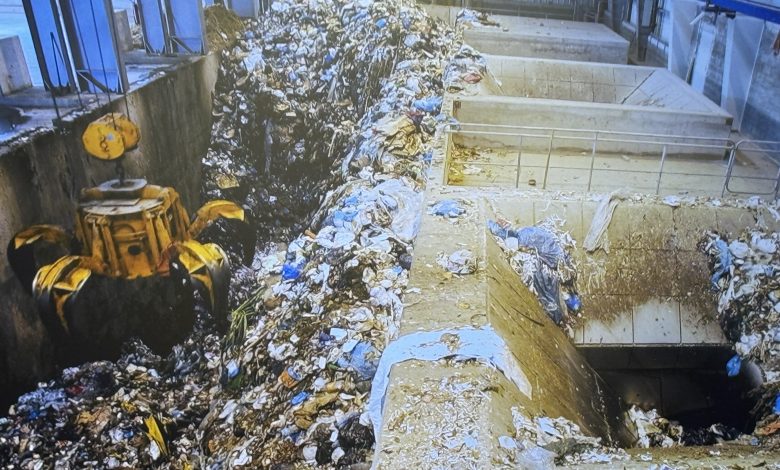
In the household waste reception pit, there is approximately 30% of food waste : all of this material could be diverted to organic recycling.
The factory produces approximately 6 MW of electricity, which are fed into the Martinique grid, helping to reduce dependence on fuel oil. It also performs a critical function: the treatment of waste from healthcare activities involving infectious risks health care facilities.
The Robert CVO: Producing High-Quality Compost, Provided the Waste Is Clean

The core issue of “biowaste and green waste” was addressed by Johan Régis, director of the Le Robert Organic Waste Treatment Center.
The CVO acts as the industrial liaison for organic recovery, particularly for larger volumes:
- the green waste (contributions from local governments, recycling centers, facilities)
- and the food waste.
The green waste process is based on grinding and a trommel (separation tool), which produces a fraction that is directly compostable and isolates coarser materials that can sometimes be reused (particularly as biomass).
When it comes to food waste, the key issue is the deconditioner, an essential tool for properly separating organic matter from packaging. After years of substandard operation, a new, more efficient deconditioner has been announced, in order to handle a greater volume of traffic.
Mr. Régis emphasized a crucial issue: the pollution from inflows. Tree stumps, rubble, pieces of glass, scrap metal, plastics… These mistakes have direct consequences:
- risk of heavy metals,
- effluent discharge,
- machine breakdowns,
- and, above all, a decline in the quality of the final compost.
He also mentioned a subtle but telling sign: the famous “brown bins” (for separate collection), which were very common in 2020, have declined sharply. In 2025, the CVO received only about 95 metric tons, most of which come from the Southern Region. The center hopes to see this number increase as it upgrades its facilities.
As for career opportunities: more than 80% Compost is now absorbed by the banana farmers, who appreciate its agronomic qualities. The site is seeking to diversify into orchards, nurseries, vegetable farming, and, gradually, other sectors.
To raise awareness of the product, compost is available on a self-service basis at certain strategic locations, including near the CVO.
VALBIODOM: Solutions for Every Business, Tailored to Its Specific Needs

Thibault Wattecamps, from VALBIODOM, offered a very “real-world business” perspective: while the law requires sorting, the real question for professionals is often: Where to start, with what resources, and to achieve what result?
Companies have a variety of objectives:
- reduce inventory levels,
- reduce management costs,
- reduce odors and pests,
- improve the carbon footprint,
- enhance the image,
- implement a truly eco-friendly approach.
VALBIODOM serves a wide range of sectors: the hotel industry, institutional food service, mass retail, healthcare facilities, the food industry, and more. Wherever food waste exists, the issue must be addressed.

Several solutions were presented:
- simple collection, or collection with weighing, a highly effective tool for raising awareness and reducing waste in the long term; ;
- dehydrator, particularly suited for large-scale retail: a reduction in volume of 80 to 90%, and the production of an inert, storable residue, which must then be reintroduced into a composting process; ;
- mechanical composter, accelerating the first phase of composting, reducing pests and odors, and offering real educational value; ;
- and even solutions tailored to individual users that are easier to use, particularly those that use hand-crank mechanisms.
A key point: Composting requires a good supply of carbon-rich material (shredded wood/wood chips). VALBIODOM states that it can offer locally sourced solutions, derived primarily from wood cuttings and suitable waste streams.
PROXIDON: Organizing Donations to Prevent Waste from Becoming Trash

The social dimension of valorization was introduced by Marie-Alizée Padra, for the solidarity platform PROXIDON.
Launched in March 2024, the platform was suspended due to a lack of dedicated staff, before being relaunched in 2025. The concept is simple: to connect donors and organizations.
How it works:
- The donor posts a wish list online,
- a local nonprofit organization reserves,
- She comes to pick it up herself.
A practical benefit: the platform also allows for a tax exemption for the donor.
The figures presented show a growing trend:
- about 15 donors today, including the Réveil agricole, the Meynard University Hospital, and an 8 à 8 store; ;
- very active organizations (Red Cross, Catholic Relief Services, Adventist Relief, Action Sida, etc.)
- 99% reserved baskets, a sign that demand is strong and that the system is working well.
She gave a telling example: 830 kg of food saved over a recent period, particularly during the 2025 holiday season, as part of an initiative spearheaded by the association Entreprises et Environnement.

Martinique Développement Expands Its Services: From Assessment to Leveraging Results
In conclusion, Ms. Morane Perion, a project manager for the circular economy and corporate ecological transition at Martinique Développement (hired in July 2025), presented the dedicated support program.
Its work is organized into three areas:
- Awareness / Information
conferences, activities, networking. - On-site Support
waste assessments, source separation, understanding local waste management systems, concrete action plan. - Access to Financing and Monitoring
Support with ADEME grants, facilitating connections, monitoring the implementation of initiatives, and promoting the results.
Ms. Perion explained that she works closely with the EPCIs (CACEM, Cap Nord, Espace Sud) to identify needs and provide businesses with close support, with one goal in mind: to move from an intention to an effective, monitored, and measurable organizational structure.
A conference that sets a new direction: sort waste more effectively, but above all, take action locally
As the presentations went on, one message became clear:
“Martinique already has the tools, systems, and expertise to make significant progress. But collective performance depends on one key factor: the quality of source separation.”
Whether you are a restaurant owner, manufacturer, distributor, local government, or healthcare facility, organic waste recycling only works if the waste is clean, consistent, and properly sorted.
By highlighting the realities of waste processing, operational challenges, technical solutions, and collaborative approaches, this second edition of «From Sorting to Recovery» served above all to remind us of one thing: the circular economy is not an abstract concept. It is a concrete system, built one company at a time, one waste stream at a time—and one that, in Martinique, can become a driver of both sustainability and competitiveness.
Thank you to Martinique Développement for organizing this conference and for its involvement in these areas.
Philippe Pied