
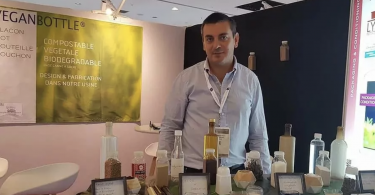
Discover the «Vegan Bottle,» a plastic bottle that doesn’t contain a single drop of petroleum. On the contrary, it’s made entirely from plant-based materials and is therefore compostable. Nicolas Moufflet, the French engineer behind this innovation, is now launching his line of spring water packaged in this eco-friendly bottle.
For the past 20 years, Nicolas Moufflet has been conducting research on new materials that could replace petrochemical-based packaging. And over the past two years, he has succeeded in finding a solution for creating 100% plant-based bottles, which he produces in Sainte, in Charente-Maritime: using sugarcane bagasse. «Bagasse is a byproduct of sugarcane. It is turned into small pellets, which are then used to make vials and bottles,», explains the packaging specialist.

Vegan bottles are made of 100% plant-based material.
Primary goal: to compost the bottles
The advantage of the Vegan Bottle—since it does not contain petroleum—is that it is compostable at the end of its life. «The bottle will thus break down safely at a waste disposal facility and will not cause any pollution because it contains no chemical molecules. Even if it ends up in the natural environment, outside the traditional waste disposal system, it will biodegrade,», highlights Nicolas Moufflet.
The composting time will vary depending on where the bottle ends up. On average, under normal conditions, 90% of the bottle will have biodegraded after six months. Composting is, in fact, the ideal end-of-life option according to Nicolas Moufflet, even though his bottles—like glass—can be recycled indefinitely. «Today, only 25% of petrochemical plastics are recycled. Recycling is highly polluting. We have created a product—the only one of its kind in the world—made from sugarcane bagasse to provide a solution to the problem of this plastic waste,», the engineer points out.

The bottles are clear by default, but can be colored—again, using plant-based materials.
Create consistency between form and content
While some manufacturers use «hybrid» bottles—that is, bottles made from a combination of petroleum and plant-based materials in a ratio of 20% or 30%—the Vegan Bottle is 100% made from sugarcane bagasse. This material comes from humid tropical regions where sugarcane is grown. Even the bottle caps and labels are biodegradable.
To add color to the bottles and enhance their design, the company once again uses plant-based materials combined with sugarcane bagasse: pits, shells, grains, wood, cocoa, coffee… «It also allows our customers to ensure consistency between their products and our bottles. For example, a bottle made from olive pits to hold olive oil, or one made from cocoa for a chocolate product. »Later on, I’d also like to put rum in sugarcane bottles!”, says Nicolas Moufflet. The only product that poses a challenge at the moment is wine. The company is currently working to find ways to ensure that the vegan bottles can hold wine over the long term, as opposed to about one month at present.

Two million vegan bottles have already been produced, a figure that Nicolas Moufflet, the creator, plans to increase even further.
Spring water in the Vegan Bottle
Nicolas Moufflet has gone even further than simply creating eco-friendly packaging. He has just launched «Vegan Bottle Water»: spring water packaged in his plant-based, compostable, and biodegradable bottles. The product has been sold directly to businesses (event organizers, trade shows, organic networks, etc.) since September 2018.
In just one year, through his company Lyspackaging—founded in January 2015—2 million vegan bottles have already been produced. A figure that the founder himself downplays. «Two million may seem like a lot, but it’s actually quite low in the packaging industry. It’s a good start, and more and more people are interested in our bottles,», he explains. Today, the majority of customers who have adopted the Vegan Bottle are in the food industry. This is despite a price that is about 30% higher than that of petrochemical containers. This difference is mainly due to the cost of the raw material.
By Agathe Perrier
Inhttps://madeinmarseille.net