

Can public procurement help protect the environment and promote social development? That, at least, is what could happen with the new regulations set to take effect in August. Environmental and social clauses will have to be incorporated into public procurement—is this a way to make the economy greener? An opportunity for actors in the social and solidarity economy?
A telling report
The government has published its evaluation report on the Programs for Promoting Socially and Environmentally Responsible Procurement (SPASER). This approach provides solutions for many stakeholders in the Socially and Environmentally Responsible Procurement (ASER) sector.
The report indicates that, of all public procurement, contracts with environmental clauses currently account for only 29.1%, and contracts with social clauses account for only 18.7% of the total.
The low rate of adoption of these clauses in public procurement reinforces the idea that they must be mandated by regulation. «The report’s central message: social and environmental clauses cannot be imposed by decree; they must be developed within an ecosystem that includes social facilitators, buyer networks, social and solidarity economy (SSE) and alternative economy (IAE) organizations, chambers of commerce, and professional federations,» states the CRESS of Martinique in a social media post.
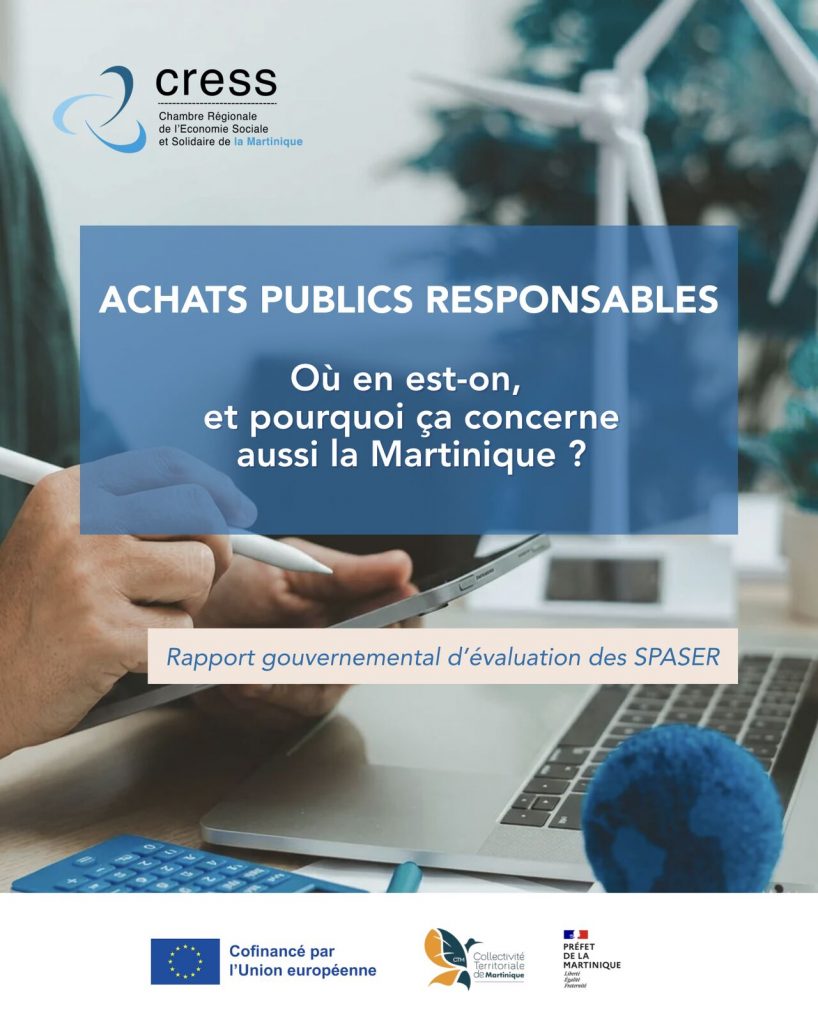
Changes in Regulations
The regulations are set to change to require the inclusion of at least one environmental clause. «Starting August 22, 2026 (in a few weeks), ALL public procurement contracts must include at least one environmental criterion and one environmental clause. A social clause will also be mandatory for contracts above the European thresholds […],» adds the CRESS of Martinique.
The social and solidarity economy is therefore on the front lines of these regulatory changes. These changes will help shift mindsets and advance best practices, and they represent an opportunity for all social and solidarity economy organizations in Martinique to secure public contracts more easily.
The CRESS in Martinique has just hired a new program manager for integration and monitoring of social and environmental clauses, whose mission is to ’facilitate this dialogue between public procurers, private companies, and social and solidarity economy organizations, so that the territory’s public procurement contracts become genuine drivers of social integration and ecological transition,« according to the CRESS. Consequently, all sectors will need to adapt—including retail, agriculture, construction, and others—and SSE actors must seize this opportunity to grow while serving the environment.