
Environment, Food, and Agriculture: How can we balance healthy, affordable, locally sourced, and environmentally friendly food? Three students sought to answer these questions by creating a documentary based on numerous interviews with local stakeholders in Martinique.
Movie Screening
The first version of the documentary was the subject of an initial film screening and discussion in February, as we reported in this publication[1].
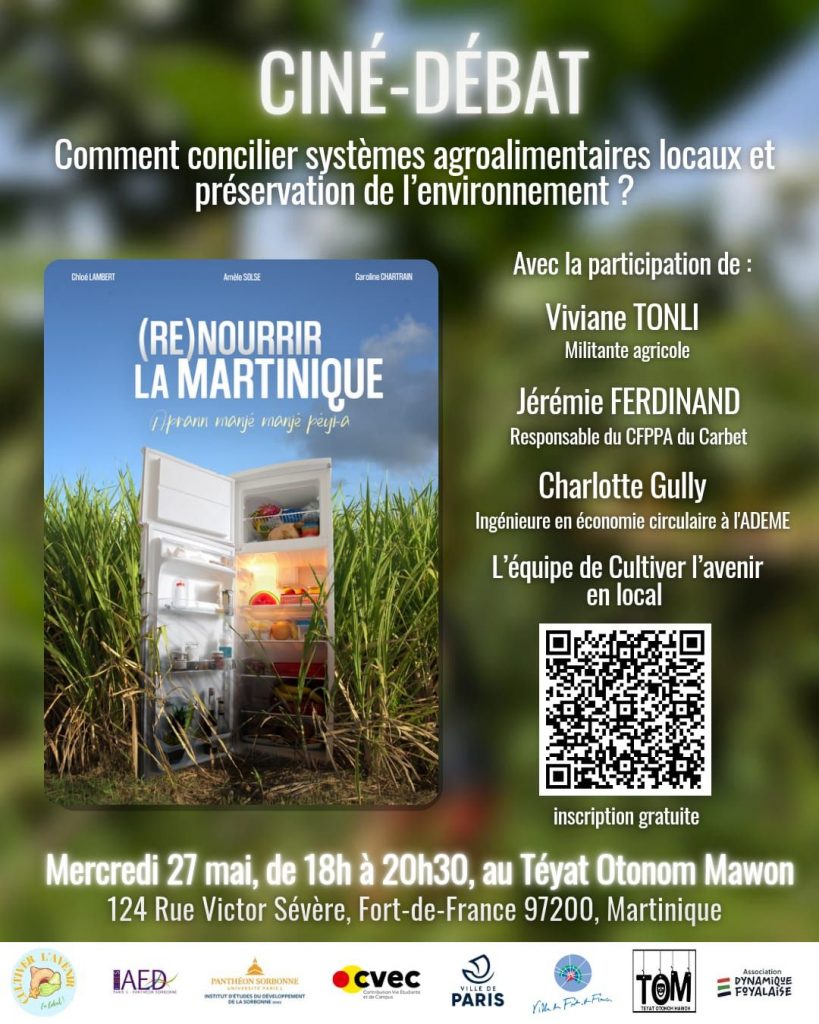
The «Cultivating the Future Locally» team will present the 2nd edition in late Maye documentary segment and is therefore organizing another film screening and discussion session centered on the following topic: How can we balance local agri-food systems with environmental conservation? The event will take place on Wednesday, May 27, 2026, from 6:00 p.m. to 8:30 p.m. at the Téyat Otonom Mawon headquarters on Victor Sévère Street in Fort-de-France. «Join us to watch the second episode of our documentary series (Re)Nourrir la Martinique,» say the organizers.
Supporters of this event include the municipalities of Paris and Fort-de-France, Panthéon-Sorbonne University, the CVEC (Contribution vie étudiante et de campus), the Étude et Développement association, and the Dynamique Foyalaise association.
Debate
The film screening will give participants the opportunity to engage in a discussion with three speakers: Viviane Tonli, an agricultural activist; Jérémie Ferdinand, director of the Carbet Center for Vocational Training and Agricultural Development (CFPPA); and Charlotte Gully, a circular economy engineer at ADEME.
The documentary is led by a trio of students—Caroline, Chloé, and Amèle—who are part of the group «Cultiver l’avenir en local» (Cultivating the Future Locally), whose goal is to better understand the challenges of food security in the overseas territories in general and in Martinique in particular. Indeed, the origin of food has numerous implications for prices, dependence on external sources, and quality. «[…] This documentary project explores how local agriculture and short supply chains can strengthen food self-sufficiency and build a more sustainable and resilient future for these unique island territories,» they explain.
Participation is free, but registration is required: here.
[1] https://martinique2050.com/un-cine-debat-pour-une-agriculture-et-une-alimentation-durable/