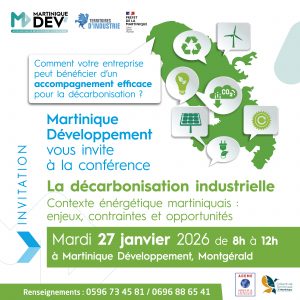
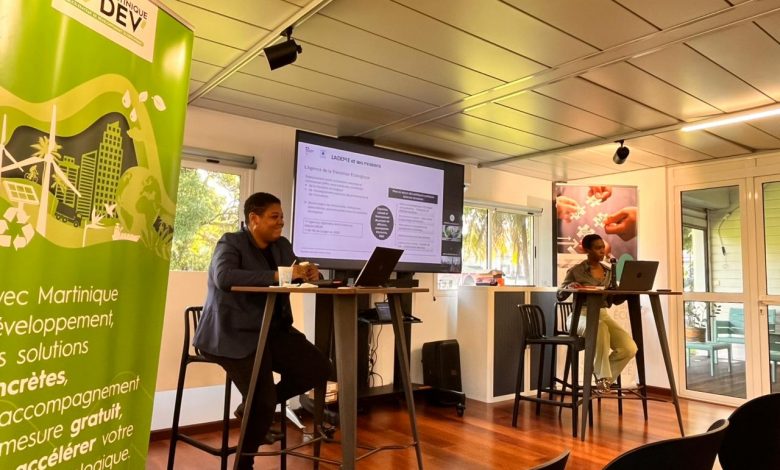
With the energy transition emerging as a strategic priority, Martinique Développement organized a conference on Tuesday, January 27, 2026, dedicated to industrial decarbonization to equip Martinique-based companies. Led by experts from ADEME and the consulting firm Kweevo, this morning session highlighted support programs, financing solutions, and operational strategies that enable manufacturers to move from intention to action.
Organized as part of the “Territoires d’Industrie” program, which supports regions with CACEM and CAP Nord designations, this meeting is part of a strategic initiative centered on four key areas: skills development, land use, ecological and energy transition, and innovation.
Martinique’s energy situation calls for action
Vincent Chausserie-Laprée, decarbonization engineer at ADEME Réunion and the overseas decarbonization coordinator provided an unflinching assessment of Martinique’s energy mix.
«Nearly 84 % of our primary energy still comes from fossil fuels, with an emissions factor of 650 grams of CO2 per kilowatt-hour generated.»,
he emphasized.
The facts are clear: while the region consumes approximately 3,000 gigawatt-hours of energy per year, thermal power plants still account for 70 % of electricity generation. This dependence on imported fossil fuels weighs heavily on the local economy, especially since
«If we reduced electricity consumption by 1 kilowatt-hour in Martinique, we would actually reduce primary energy consumption by 2.7 kilowatt-hours.»,
due to the low efficiency of the production facilities.
This energy inefficiency, combined with the rate equalization system that artificially keeps electricity prices at metropolitan levels, creates a paradoxical situation: it is in the government’s best interest to provide massive support for decarbonization in the overseas territories in order to reduce its compensation costs.
Massive aid to support manufacturers
In light of these challenges, ADEME has significantly increased its support for businesses.
«In 2024, we provided nearly one billion euros in aid to French companies, including 36 % earmarked for energy efficiency and industrial decarbonization.»,
Vincent Chausserie-Laprée explained. The programs cover the entire decarbonization process, from initial assessments to major investments.
Among the available tools, the «Mon Parcours Économie Énergie» program offers free support through energy advisors located at Martinique Développement, the MPI, and the CMA, among other places. These experts can guide businesses on regulations, appropriate technical solutions, and securing financing.
ADEME also funds energy audits (with funding rates of up to 80 %), feasibility studies for process electrification, and structural investments through the Decarbindustrie program or sector-specific calls for projects. In addition, there are Energy Savings Certificates (CEE), administered by private entities such as EDF, which can fund up to several hundred thousand euros worth of work.
Decarbonization: A Challenge for Operational Performance
Audrey Limeri, from the Kweevo Firm, provided further insight by demonstrating that decarbonization is not merely a matter of direct energy.
«About 65 to 80 % of a company's carbon footprint comes from its supply chain: transportation, raw materials, inventory management, and waste generation.»,
she explained.
Drawing on the principles of Lean Management, Kweevo helps identify and reduce «muda» (waste): overproduction, inefficient transportation, excess inventory, waiting time, and quality defects. Using the fictional yet realistic example of «Tropic Confit,» a small agri-food business in Martinique, Audrey Limeri demonstrated how a data-driven analysis can precisely quantify these inefficiencies and prioritize the most cost-effective actions.
Result: a productivity loss of 15 %, annual cost overruns of 8,500 euros, but above all, clear courses of action to simultaneously reduce operating costs and CO2 emissions. Some companies can thus reduce their costs by 30 % while drastically decarbonizing their targeted processes.
Lessons Learned to Inspire Action
Julie Barthélémy, corporate engineer at ADEME Martinique, wrapped up the morning by presenting real-world examples of companies in Martinique that have taken the plunge. These testimonials helped participants realize that, beyond the technical and financial aspects, decarbonization also relies on team engagement and a clear strategic vision.
This conference demonstrated that industrial decarbonization is not merely a regulatory or environmental requirement: it is a driver of competitiveness, innovation, and resilience. As Alexandre Ventadour, president of Martinique Développement, pointed out, the goal is to give Martinique’s manufacturers the tools they need to move from intention to action, thereby making Martinique a model of sustainable performance in the Caribbean.