
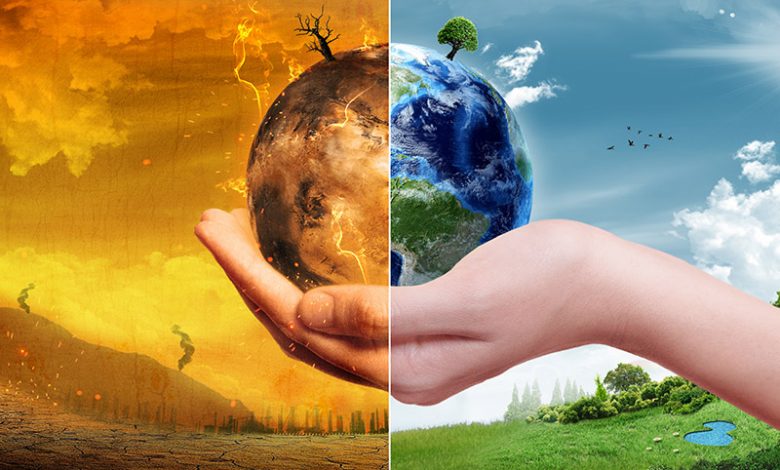
Climate change is a long-term change in the physical parameters of the Earth’s climate, and more specifically, in the various regional climates. These changes result from mechanisms intrinsic to the Earth, external influences, and human impacts.
Since its inception, the Earth has undergone numerous climate cycles: ice ages have alternated with much warmer periods, known as wet periods at low latitudes. While these dynamics have entirely natural causes, human activity—particularly industrial activity—appears to be responsible for contemporary global warming. This is primarily the result of greenhouse gas emissions (CO2, methane, fluorinated gases, etc.) into the atmosphere.
The Main Causes of Climate Change
Generally speaking, climate change refers to all changes in climatic characteristics at a given time and in a given place, whether this results in global warming or global cooling.
Natural factors external to the climate system—such as increased volcanic activity, changes in the Earth’s axial tilt, an increase in the Earth’s orbital ellipse around the Sun, and polar flattening (polar precession)…have been identified as potential factors that cyclically alter (over tens of thousands of years) the established climate.
Climate change can also result from human activity; this is the case, for example, with the excessive consumption of fossil fuels (coal, natural gas, oil), as well as firewood, which release large volumes of greenhouse gases (carbon dioxide, methane, nitrous oxide, etc.) which, by accumulating in the lower layers of the atmosphere (the troposphere) like a blanket, trap the infrared radiation emitted daily by the Earth and thus keep the Earth’s temperature higher than usual. Deforestation also contributes to this phenomenon, since trees no longer absorb CO2, which contributes to the greenhouse effect (the abnormal accumulation of heat in the lower layers of the atmosphere). Between 1860 (the start of the First Industrial Revolution) and 2010, the concentration of pollutants in the atmosphere rose from 280 ppm (parts per million) to just over 400 ppm, thereby significantly intensifying the greenhouse effect.
 The Consequences of Climate Change
While in its first report, the IPCC (Intergovernmental Panel on Climate Change) estimated that the role of human activity in global warming was approximately 55 %, in its latest report (2014), this probability has now risen to 95 %.
The best-known and most noticeable effects of climate change are: the melting of high-mountain glaciers and ice caps, rising average sea levels, coastal flooding, population displacement (now referred to as “climate refugees”), desertification, ocean acidification, and the spread of certain diseases that were previously confined to specific regions.
For example, it is estimated that if nothing is done to reverse the trend, by 2100 the global average temperature is expected to rise by +1.6 to +5.4 degrees Celsius. It is worth noting that between 1900 and 2000, the global average temperature rose by +0.85 degrees Celsius. Similarly, the average sea level has risen by more than 25 cm over the past 100 years.
Researchers also believe that, in the long term, climate change will lead to disruptions in the water cycle, agricultural challenges, and the emergence of processes such as desertification; the disappearance of certain coastal areas and/or habitats, such as deltas, mangroves, and coral reefs; a resurgence of malaria; the spread of infectious diseases such as cholera; and, more generally, an acceleration of biodiversity loss.
Ultimately, what sets today’s situation apart from the climate variations observed in the past is that the average rate of warming in the lower layers of the atmosphere is high and appears to be accelerating, with nothing and no one able to stop it.
It is therefore important to begin implementing adaptation and mitigation measures to address this phenomenon today. COP 21 (21th The Conference of the Parties, to be held in Paris at the end of the year, is expected to play this role…
There's a lot of talk about the greenhouse effect—what is it?
The natural greenhouse effect therefore shapes our climates and ecosystems. Many of these gases occur naturally in the atmosphere, but human activity is now increasing the concentration of some of them, which contributes to the formation of an additional greenhouse effect (caused by human activity).
There are various greenhouse gases: carbon dioxide, methane, chlorofluorocarbons, ozone, etc. Carbon dioxide is the greenhouse gas produced in the greatest quantities by human activities; its concentration in the atmosphere is estimated to have increased by 31 % since 1750.
These emissions are primarily caused by the combustion of coal, oil, and natural gas. Deforestation and the expansion of livestock farming are also significant sources of emissions, as trees normally help regulate the climate by absorbing carbon dioxide (CO2) from the atmosphere. Therefore, when trees are cut down, this positive effect is lost, and the carbon stored in the trees is released into the atmosphere, thereby exacerbating the greenhouse effect. Cattle and sheep also produce large amounts of methane, which they release into the atmosphere during the digestive process.
This increase in the greenhouse effect caused by human activity is a cause for concern, as emissions of these gases have the potential to warm the planet to levels never before reached. Such changes could have environmental, economic, and social repercussions that are completely unpredictable—and perhaps even irreversible…
Linsey MONPELAT, Pascal SAFFACHE