A New Year for Biodiversity Conservation. Human activities can have an impact on marine biodiversity, just as a lack of understanding of living species can degrade their habitats, potentially leading to their destruction. If we do not understand living organisms, we cannot preserve them. It is in this context that the Grand Port de la Martinique and the CNRS have joined forces to establish a dedicated facility.
Protect the corals at all costs
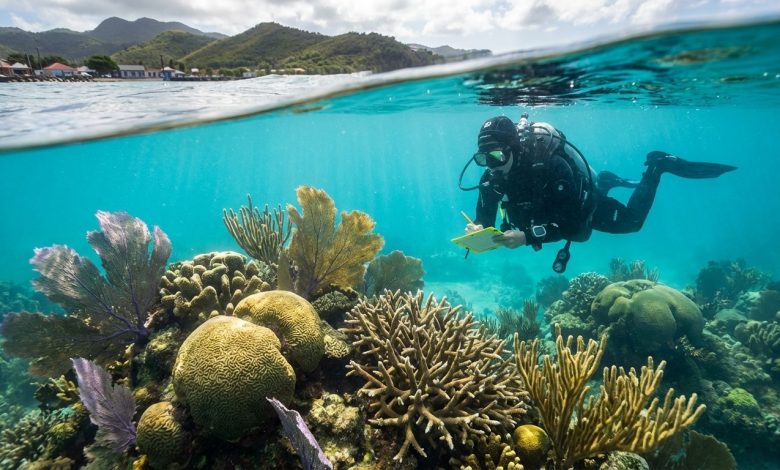
In early January 2026, a new initiative to preserve Martinique’s coral reefs was launched. This project, born out of a partnership between the Grand Port de la Martinique and the CNRS, has been named Lab’o Coraux and is based at the Pointe des Carrières site, according to an announcement by the Grand Port Maritime de la Martinique.
This joint partnership between a maritime industry player and the CNRS research organization underscores the importance for all stakeholders of preserving the marine environment, which can be an essential source of economic development for supply chains, but biodiversity must not be neglected. This initiative reflects a shared need to protect coral biodiversity.
Regional Degradation
This project is being launched at a time when awareness is growing across the region, throughout the Caribbean basin. «The Caribbean region accounts for only 1 % of the Earth’s marine environment, but is home to 10 % of the world’s coral reefs, including fringing reefs, which are the most common, barrier reefs such as the Mesoamerican Reef, which is the largest barrier reef in the Western Hemisphere, bank reefs, patch reefs, and a few atolls,» states the Global Coral Reef Monitoring Network (GCRMN).
Serving the Community
In a press release, the two partners announced that the creation of Lab’o is an initiative resulting from the signing of an official agreement on September 3, 2025. «With Lab’ô Coraux, the Port is taking a new step forward in its sustainable development strategy by relying on research and experimentation to reconcile port operations with the preservation of marine environments. This is a project with a promising future for Martinique,» explains Bruno MENCE, Chairman of the Executive Board of the Grand Port Maritime de la Martinique, in a press release from the CNRS, and Jean-Raphaël GROS-DESORMEAUX, director of the CNRS’s «Pouvoirs, Histoire, Esclavages, Environment in the Atlantic and Caribbean (PHEEAC) at the CNRS, adding: »This partnership is fully aligned with the PHEEAC’s missions and the CNRS’s policy in Martinique: to develop world-class research rooted in local communities, accelerate the socio-ecological transition of the port, and strengthen scientific observation of coastal environments to support informed public policy.”.
The partnership between two organizations that are as different as they are complementary is essential to preserving marine resources and promoting respect for biodiversity. Teaching and learning more about corals will help us care for them and protect them from potential destruction.
S.D.