
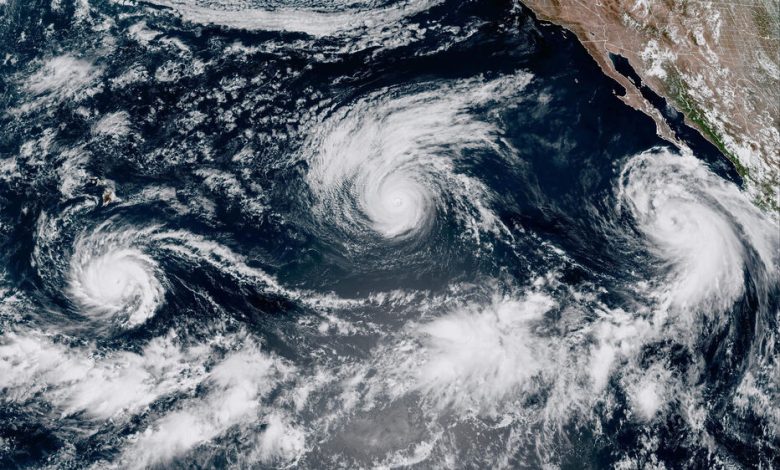
It won’t subside until 2027. The World Meteorological Organization (WMO) has never been more certain: El Niño is expected to become «very intense» by the end of the year. Record heat, droughts, floods—the entire world is affected. The Caribbean, too.
100 %. The WMO has never been so certain
El Niño is here. The question is no longer whether it will last, but how high it will rise.
According to the latest forecasts from the WMO, the United Nations weather agency, the probability that the phenomenon will persist through February 2027 is close to 100 %. This is a first. Neither for El Niño nor for La Niña—its cold counterpart—had the organization ever issued a forecast with such a high level of certainty.
The peak is expected toward the end of the year. The effects, however, will continue into 2027.
«The planet is sailing into uncharted waters, and those waters are getting warmer.» António Guterres, UN Secretary-General
+8 °C below the surface of the Pacific
El Niño is a natural phenomenon. It occurs every two to seven years: the waters of the central and eastern equatorial Pacific warm up, atmospheric circulation is disrupted, and both temperatures and precipitation are affected as a result across the entire planet.
What's different this time is the context. The episode takes place on a planet that has already been warmed by greenhouse gases, with exceptionally warm oceans.
The figures speak for themselves. The Niño 3.4 index, the benchmark for tracking the phenomenon, stood at +1.5 °C from May through July, then at +2 °C in July. Between late July and mid-August, weekly readings fluctuated between +2.2 °C and +2.6 °C above normal.
Even more striking: beneath the surface, in certain areas of the tropical Pacific, water temperatures have exceeded normal levels by more than 8 °C. This heat accumulated at depth supports forecasts of increased intensity.
Key Figures
- ~100 %: probability that El Niño will last until February 2027
- 2.2 to +2.6 °C: Weekly anomaly of the Niño 3.4 index (late July–mid-August)
- 8 °C: anomaly detected below the surface in certain areas of the tropical Pacific
- Ages 2 to 7: typical frequency of the phenomenon
«Little Boy,» Big Damage
A very intense El Niño does not necessarily mean disasters everywhere or of the same magnitude. Its effects vary by region and season and interact with other oceanic and atmospheric phenomena.
But for September through November, the WMO models are clear: above-normal temperatures across nearly all land areas. In terms of rainfall, the El Niño pattern is expected to intensify, bringing heavier precipitation to some regions and more drought to others.
Two factors could still change the picture: a positive phase of the Indian Ocean Dipole, which could amplify or mitigate certain effects, and a tropical Atlantic that is expected to remain warmer than normal.
«El Niño means “little boy” in Spanish, but it has the potential to deal a massive blow to communities and economies around the world.» Celeste Saulo, Secretary-General of the WMO
What about Martinique?
The WMO press release does not specifically mention the Caribbean. However, two points directly concern the Caribbean region.
First, the warmer-than-normal tropical Atlantic, as noted by the WMO: this is the basin that feeds our hurricanes and determines our temperatures.
Next, the major trends typically seen during El Niño years in the region: a generally less active Atlantic hurricane season and an increased risk of dry spells in the Caribbean. These are trends, not certainties: each event is different, and the WMO emphasizes that the effects are «highly variable» depending on the region.
On an island that imports most of its food and depends on its water resources, these signs warrant close monitoring.
«Exceptional preparation»
Faced with a situation that is expected to persist, the WMO states that it has launched an unprecedented mobilization effort with national meteorological and hydrological services. The goal is to strengthen forecasting and early warning systems so that governments and humanitarian organizations can anticipate the impacts on agriculture, health, energy, and water.
«This exceptional El Niño calls for exceptional preparation and response,» insists Celeste Saulo. By late July, the WMO had already warned that the event would intensify. A month later, its forecasts had become both more serious and more certain.
Key Takeaways
- El Niño is expected to last until February 2027, peaking in late 2026
- The WMO has never issued a forecast with such a high degree of certainty
- Above-normal temperatures are expected almost everywhere from September through November
- The effects vary greatly by region
- «Unprecedented» mobilization of weather services for early warning