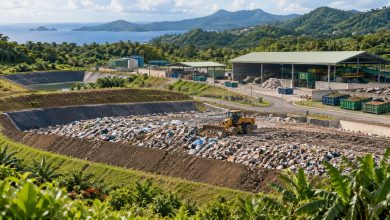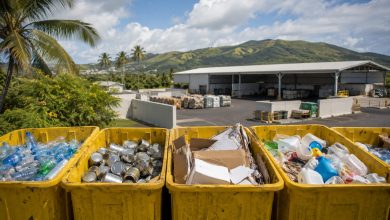

Installing recycling bins is not enough to ensure effective collection. In an article published and illustrated with a case study from the CACEM region, Jean-Yves Bonnaire highlights the difficulty of predicting how these facilities will actually be used. Usage rates, improper disposal, collection costs, and user behavior can lead to results that differ significantly from those anticipated at the time of installation.
A waste collection station may seem like a relatively simple piece of equipment. You choose a location, estimate the number of potential users, determine the appropriate size of the station, and organize the necessary collection routes to empty it.
But there can be significant differences between how things are supposed to work and the reality on the ground.
This is precisely the point made by Jean-Yves Bonnaire in a recent publication on household waste pre-collection facilities, particularly drop-off stations.
In his view, their implementation inevitably involves a degree of uncertainty. Even when the decision is based on preliminary studies, several factors come into play simultaneously: technical constraints, costs, logistical organization, regional characteristics, and, above all, human behavior.
Charging stations that are sometimes underutilized
The first risk is that of miscalculating attendance.
A local government may install equipment based on an estimated number of users, only to find that residents are not using it as much as expected. The investment is then called into question in light of its actual usage.
But the opposite can also happen.
Some trash cans become gathering spots for trash that wasn't supposed to be thrown there.
Jean-Yves Bonnaire thus refers to genuine «trash magnets», based on a photograph taken within the CACEM territory. Additional drop-off points may then appear around a facility originally intended for waste collection, sometimes unrelated to the station’s primary function.
The system designed to improve collection may thus, under certain circumstances, inadvertently contribute to the concentration of deposits in a single location.
Two identical terminals, two different realities
Another issue raised was how often the equipment must be emptied.
Two seemingly comparable terminals may have very different usage levels. This has direct implications for route planning, the necessary human and material resources, and, ultimately, the cost of the service.
So the question isn't just about how many charging stations to install.
It is also important to understand how they will actually be used and to be able to adapt the collection process accordingly based on observed behaviors.
In addition, it is important to follow the sorting guidelines. When some users dispose of inappropriate waste in a collection facility, the quality of the collected waste stream can deteriorate, making it more difficult to recycle.
Collection isn't just a matter of logistics
This line of thinking leads Jean-Yves Bonnaire to look beyond the issue of facilities alone.
Collection performance obviously depends on the available resources, the number and type of vehicles, the frequency of collection runs, and the organization of the various waste streams.
But it also depends on factors that are much more difficult to model: residents’ habits, travel patterns, how a neighborhood is used, individual behaviors, and the social dynamics specific to each area.
A technically well-designed facility may therefore produce disappointing results. Conversely, a facility may see far more visitors than anticipated.
That is the challenge of public policy when it comes up against human behavior that cannot be fully predicted.
Observe, experiment, and correct
Jean-Yves Bonnaire does not conclude from this that we should give up on planning.
Instead, he advocates an approach in which the installation of equipment is the beginning of a process, not its end.
The goal is to observe what actually happens after it is installed, evaluate the results obtained, and, when necessary, adjust the system.
The location of the bins, their capacity, the frequency of collections, information provided to residents, and the organization of collection routes may therefore need to be adjusted based on observed usage patterns.
This approach amounts to viewing waste management as a system that must be continually adjusted rather than as an organization that can be fully defined in advance.
In his view, the complexity of the situation can even become a driver of innovation, forcing local governments to learn from actual usage patterns rather than trying to anticipate everything.
In a region like Martinique, where waste management is a major environmental, financial, and organizational challenge, this discussion ultimately raises a simple question: How can we design public facilities that are flexible enough to be adapted to users' actual behavior?