The 2nd Annual International Robotics Challenge R2T2 Américaraïbe, which we discussed in early April, It happened!
Using robots, the students carried out a rescue mission to save a Caribbean city threatened by a tsunami… Students from Martinique, Saint Lucia, Nice, and Mexico took on this challenge.
A look back at this event in pictures! Viewed from Mexico…
R2T2 AmeriCAraibe “Operation Richter” Mexican Section 2018
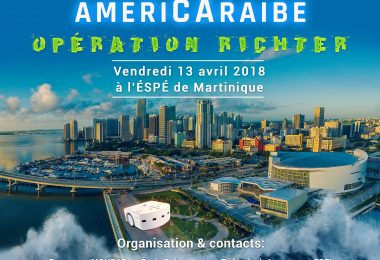
On April 13, 2018, the Martinique ESPE hosted the second edition of the R2T2 AmeriCAraibe international educational robotics challenge, dubbed «Operation Richter.».
More than a hundred students aged 8 to 14 from Martinique, Mexico, Saint Lucia, Nice, and other places pooled their computer skills to carry out a rescue mission to save a Caribbean city threatened by a tsunami!
Since 2016, the ÉSPÉ in Martinique has played a central role in organizing this collaborative project led by the École Polytechnique Fédérale de Lausanne (EPFL) and the National Institute for Research in Computer Science and Automation (INRIA).
A Comprehensive and Innovative Training Program on Major Risks: Numérisk’AmeriCAraibe
This challenge is part of a broader, comprehensive initiative called Numerisk’AmeriCaraibe. It’s an awareness-raising project focused on major risk prevention, rooted in the realities of our region, that gives young people a voice! It aims to engage Martinique’s rising generation—the future citizens—in thinking about the development of their region. Its goal is to prepare them to handle emergency situations (ensuring their own safety and providing assistance) through digital activities conducted in Martinique and in countries in the Caribbean and the Americas that face similar risks (Mexico, Haiti, St. Lucia, Dominica, etc.).
Working in teams, students from fourth grade through twelfth grade will devise and collaboratively develop creative solutions and Smart City prototypes to address major risks. The initiative aims to empower the youth of Martinique to take the initiative in seeking solutions through strategic plans currently being implemented in their region, as well as throughout the Caribbean and internationally. Building on this foundation, they will be able to look ahead and envision the solutions of tomorrow.
AN OPENING TO THE INTERNATIONAL COMMUNITY AND TO EDUCATIONAL COOPERATION
Led by the digital services department of the Martinique ESPE, the project is being carried out in partnership with Martinique’s civil defense agency and key stakeholders in major risk prevention in our region: the Prefecture, DEAL, CTM, the Education Academy, etc. It is part of a broader effort to foster educational cooperation in the Caribbean and the Americas.
This creative project offers a wealth of opportunities for interdisciplinary learning (mathematics, science, history, geography, etc.). It is designed to develop 21st-century skills: collaboration, creativity, problem-solving, critical thinking, etc.
Scenario for the AmeriCAraibe R2T2 Challenge: «Operation Richter»
It is the year 2047, and regions with high seismic risk have embarked on a collaborative effort. They have invested in research and education to develop innovative infrastructure and smart, resilient cities capable of withstanding major risks. A violent earthquake has been recorded; our region has been shaken by the tremors. There are no casualties, but some structures have collapsed. The worst is yet to come: a tsunami is expected to hit our coastline within the next 1 hour and 30 minutes. Fortunately, researchers and engineers have designed and built innovative systems to protect the city. To keep people safe, robots will be remotely programmed to activate our Smart City’s protection systems!
The Morning's Schedule
The students were given an official welcome presided over by the Director of the Martinique ESPE
The president of Martinique’s civil defense agency briefed them on the procedures for establishing a crisis command center in the event of a major incident.
The students then selected their representatives (prefect, SDIS director, etc.). The teams were ready to take on the challenge.
The launch video was viewed simultaneously in all participating countries. A challenging mission to complete in 1 hour and 30 minutes, before the arrival of a tsunami. Our budding engineers had to control robots to secure four strategic locations: the hospital, the airport, the power plant, and the desalination plant that supplies the city with drinking water. To help the «programming experts» coordinate their actions, the EPFL research team—the robot designers—set up a system that allowed the teams to monitor the robots’ progress remotely.
The pressure is mounting—the city must be secured within 1 hour and 30 minutes. The teams are assigned to four sectors and must develop their strategies by communicating with each other in French [thanks to the involvement of French teachers in Saint Lucia and Mexico], as well as in English. Some teams are struggling—the tsunami is coming…
Fortunately, robots were able to take up positions at the four strategic points; the defense system has been activated, and the city's protective shield has been deployed.
The children from all participating countries are relieved: mission accomplished—the city is safe!