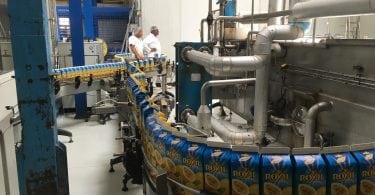
The Desnel factory is a company that has been in business for over 100 years; it was founded in 1908 in Gros-Morne by Baron Pierre Daniel Jullien de Saumery. It began as a pineapple cannery; over time, the company restructured and is now a producer of juices and jams sold under the Royal brand.
Local and healthy products
The company is making significant efforts to improve its environmental performance. Throughout the year, it sources its produce from about 50 growers in Martinique who supply guava, bananas, Cythère plums, and many other fruits. “We try as much as possible to source our ingredients locally, close to the factory; the advantage is that we’re in Gros-Morne, right in the center of the island. We’ve promoted a fruit-based supply chain policy by making most of our products with fruit from Martinique. This has allowed us to increase the proportion of fruit pulp processed directly at the factory from fruit grown by local farmers, and we’re gradually reducing our imports of fruit pulp. However, to limit risks for producers, when we launch new products, we first test them using imported fruit. For example, with Cythère plums, we initially purchased a large quantity from Santo Domingo to test the concept, and now that it has proven successful, we produce Cythère plum pulp exclusively from local produce. ”We work in cooperation with various producer organizations,” explains Director Philippe Vourch.
The factory also works with individuals who can bring in the fruit they harvest from their gardens. In addition, the factory’s 30-hectare landholding is farmed organically or certified as having High Environmental Value. Thanks to this, Royal was recently able to launch an organic line.
To improve crop pollination, 40 beehives have been set up in the middle of the orchards. The orchards are maintained by 18 sheep that graze freely in the pineapple fields.
Energy conservation is a priority.
A wastewater treatment plant was installed to treat wastewater. When the pipes are cleaned, the water is collected, treated, and, once clean, returned to the river or used to irrigate the fields. The wastewater treatment plant will soon be modified to use planted reed filters, which will reduce electricity consumption.
All fruit waste from the facility is composted and then used on farmland.
The factory is planning to install solar panels on the roofs of its future cold storage facility.
Denel aims to cut its fossil fuel consumption in half within the next 10 to 15 years as it shifts toward renewable energy.
People at the heart of corporate policy.
“On the social front, we support local organizations that share our values and focus on issues we care about. ”We support the Trinité rowing team, the Gros-Morne Cycling Club, the Gros-Morne Reveil Sportif handball and soccer teams, and many other cultural and sports organizations,” the director tells us.
The company's employees are also committed to mentoring young people. The factory often takes on young people for internships or work-study programs, and some of them are eventually hired.
Denel strives to have a positive impact on its environment. It operates a local, sustainable factory that is open to visitors every Thursday.
Kaylan Fagour