The DEAL Martinique activity report for the year 2025 highlights several initiatives undertaken to support the territory’s energy transition. From the development of renewable energy and support for local governments to ecological planning and the promotion of solar energy, the document provides an overview of the initiatives led or monitored by government agencies as Martinique seeks to strengthen its energy resilience and reduce its dependence on fossil fuels.
While not intended to provide an exhaustive overview of Martinique’s energy system, this assessment nevertheless helps identify several trends and key projects that are contributing to the region’s transformation.
The energy transition is now part of ecological planning
One of the key takeaways from the report is the growing integration of energy issues into a more comprehensive approach to the ecological transition.
The DEAL notes that its Risks, Energy, and Climate Division (SREC) is responsible for the local implementation of public policies related to climate and energy. In 2025, this work notably resulted in an active contribution to the regional implementation of ecological planning in Martinique.
Government agencies participated in workshops that led to the development of a regional assessment and a roadmap covering several strategic areas, including energy, waste, and environmental data.
This initiative aims to better coordinate public actions and strengthen the coherence of policies implemented across the region.
A 26.5 % share of renewable electricity in the energy mix
Among the indicators presented in the report is the share of renewable energy in Martinique’s electricity generation.
According to data compiled by the DEAL, 26.5% of the electricity generated in the region comes from renewable sources.
This indicator illustrates the progress made in diversifying local energy production sources. It also underscores the importance of the efforts still needed to continue reducing dependence on imported energy in an island territory that is particularly vulnerable to fluctuations in international energy markets.
Municipalities are rallying around renewable energy acceleration zones
The report also highlights the rollout of Renewable Energy Acceleration Zones (ZAER), a program designed to facilitate the identification of the areas most conducive to the development of future projects.
To support local governments, the DEAL has developed tools, organized technical meetings, and hosted dedicated webinars.
According to the report presented, By the end of 2025, 23 municipalities in Martinique had completed their mapping of ZAERs, whereas Thirteen municipalities had already passed a resolution on this zoning plan.
These steps represent an important milestone in the land-use planning for future energy projects, even though they do not yet guarantee that the facilities that might result from them will actually be built.
Solar energy remains one of the most visible sectors
The report also highlights several advances in the field of photovoltaics.
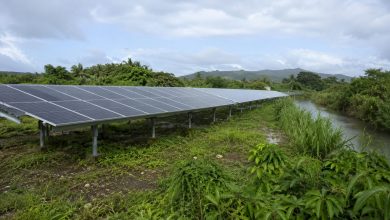
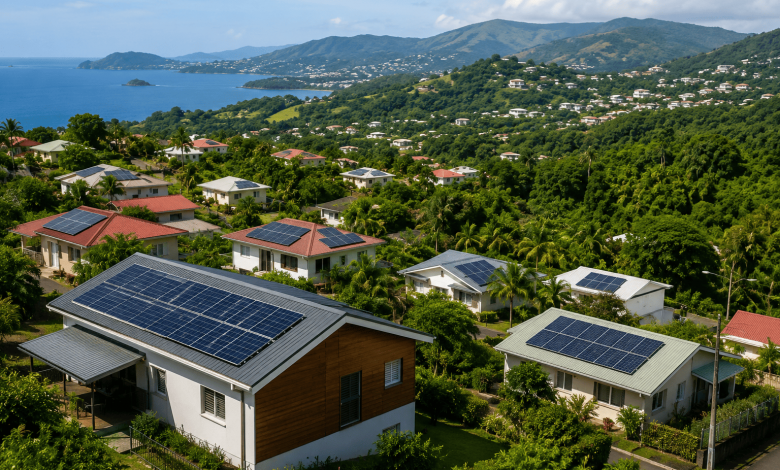
In 2025, Four solar power plant projects have been approved, representing a total capacity of 9.3 MWp. These projects involve various types of installations, including ground-mounted systems, rooftop systems, and photovoltaic shade structures.
The DEAL also highlights the development of the Solar Cadastre of Martinique, a tool available to the public that allows users to assess a building’s solar potential and estimate the savings that can be achieved by installing photovoltaic panels.
Showcased at several events throughout the year, this tool had a total of 2,618 visits since it went into service, including 1,086 recorded in 2025, for 2,264 unique visitors.
Beyond the technical aspects, this platform aims to facilitate access to information and encourage individuals, businesses, and local governments to take ownership of energy issues.
Key infrastructure projects still in the planning stages
The report also outlines several prospects for the coming years.
Among these is the ongoing revision of the Multi-Year Energy Plan (PPE), carried out jointly by the French government and the Territorial Collectivity of Martinique. This strategic document is intended to define the territory’s energy policy for the coming years.
The DEAL also mentions its contribution to discussions on the development of new energy sectors, particularly geothermal energy, which is regularly identified as a potential driver for diversifying Martinique’s energy mix.
This work is taking place against a backdrop in which energy issues are increasingly intertwined with land-use planning, climate resilience, and regional development.
An overview of the initiatives undertaken to support the transition
The DEAL Martinique 2025 Activity Report does not provide a comprehensive overview of the territory’s energy situation. However, it does offer useful insight into several initiatives, programs, and projects that are being monitored or supported by government agencies in this area.
The rollout of ZAERs, contributions to ecological planning, the approval of solar power projects, and the promotion of the solar cadastre: these initiatives demonstrate a commitment to gradually establishing the conditions necessary to accelerate the energy transition.
As Martinique continues to explore its energy future, these initiatives illustrate the growing importance of energy issues in long-term public policy and in preparing the region for the challenges of the coming decades.
THE 2025 ACTIVITY REPORT OF THE DEAL MARTINIQUE IS AVAILABLE AT THE FOLLOWING LINK: https://www.martinique.developpement-durable.gouv.fr/rapport-d-activite-2025-de-la-deal-martinique-a2685.html