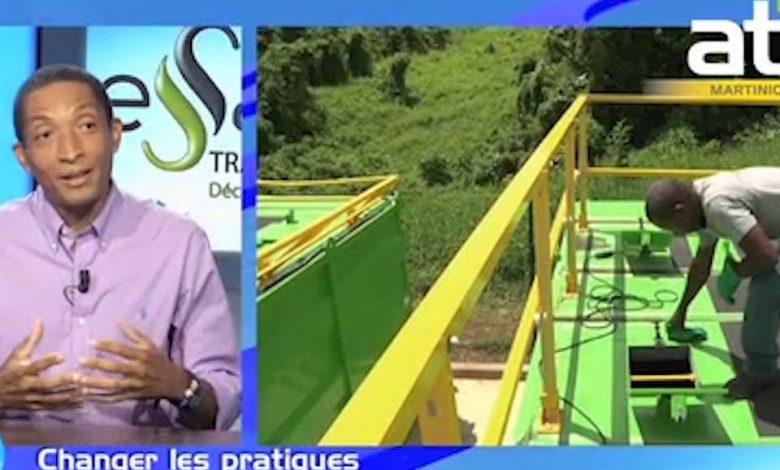
On Saturday, April 7, in the Duhaumont neighborhood of the town of Marigot, the first platform was inaugurated Essainia for the treatment and recycling of wastewater from on-site sewage systems in northern Martinique.
The Project
A first for Martinique and all French territories, this innovative wastewater treatment and sanitation facility will treat and recycle wastewater from non-centralized domestic sewage systems in the island’s Northern Zone.
Designed to accommodate waste collectors from approved companies, this facility will not only process wastewater from on-site treatment systems but will also convert sludge into compost and reuse excess water as industrial water.

Mr. Jean-Marc Ampigny
Addressing the Challenges Facing Martinique
For more than 20 years, Jean-Marc Ampigny, the developer of this first platform, Essainia, is working to implement this project. With a focus on environmental issues, he has identified solutions that align with the objectives of planned public projects.
The percentage of Martinique’s population that is not connected to a centralized wastewater treatment system is approximately 60 %, which is roughly equivalent to 78,000 septic tanks. Martinique must manage 100,000 m3 of sludge per year. Until now, there was only one treatment facility on the island, located at La Trompeuse within the CACEM territory.

On the left, in black, is the homogenization tank; on the right are the processing tanks.
Essainia By the Numbers
This new platform Essainia can process up to 80 m3 per day. After a three-month pilot test to validate the system's operation, the test results are very satisfactory, with a success rate ranging from 70 % to 100 %.
The 2.6 million euro project was implemented with 58 % in public funding and 42 % in financial contributions from the developers.
Two site managers have been trained and will be available to assist waste removal professionals six days a week—Monday through Saturday.
Two other platforms Essainia should be established in the coming years to meet the population’s sanitation needs. One in the center of the island, outside the CACEM zone, and one in the southern part of the island.

Pre-treatment lines
Economic and Environmental Benefits
The proximity offered by this new platform in northern Martinique will facilitate waste disposal operations and improve access for waste disposal professionals. Reduced travel time leads to less wear and tear on tires, lower fuel consumption, and reduced transportation-related equipment costs, in addition to lowering carbon emissions from trucks.
The platform itself converts sludge into compost and wastewater into industrial water, and allows for quality monitoring through the traceability tool that has been implemented. The quality of waterways and bodies of water will be improved.

From left to right: Mr. Jean-Marc Ampigny, Mr. Joseph Péraste, Mr. Louis Boutrin, Mr. Franck Robine, and Mr. Claude Lise
Attendance of numerous officials
For the inauguration of this innovative project, many prominent figures attended to commend the work done to establish this major facility, which serves as a model in both economic and environmental terms. Sponsored by Mr. Claude Lise, President of the CTM Territorial Assembly and the ODE, the event highlighted the political courage and the significance of the economic benefits of this project. Also present at the inauguration were Franck Robine, Prefect of Martinique; Louis Boutrin, representative of the CTM executive; Joseph Pérastre, Mayor of Marigot; and the island’s key water sector stakeholders.

Site tour and explanation of how it works
Tour About the site and an explanation of how it works.
The sludge collected and transported to the site will be discharged into two pretreatment lines. At this stage, a quality control check is performed on the material to ensure that it does not contain any hydrocarbons or grease. If the material meets the requirements, it is sent to the homogenization tank.
At this stage, the sludge is mixed with a polymer to thicken it and then sent to filter tanks, where the sludge and excess water are separated.
The sludge is then sent to separation and filtration units to increase its dryness content, and the water is stored and sent to tanks where it will be treated before being disinfected.
In a gravity-fed system, the water will flow to the utility room and be sampled every 1,000 L for analysis. The water is not potable but may be used as industrial water for filling and washing trucks. Any excess, unused water may be discharged into the environment without posing a risk to the environment.
The sludge will be transported to the Organic Waste Treatment Center (CVO) to be turned into compost.
[youtube https://www.youtube.com/watch?v=GM7k6JDh7nQ?rel=0]
Mariska Desmarquis

Phone: 05 96 58 50 69