
MétaSystème, a cooperative dedicated to workforce integration, offers training for cutting-edge professions. During a visit to the workshop at Saint-Esprit Middle School, Jimmy Lagrandcourt, a trainer and co-manager, spoke with us about the organization’s goals, initiatives, and future projects.
What is MetaSystem?
At first, MétaSystème was an association called PNPE (Protection of Nature Through Employment), which unfortunately did not work out. Together with the people who stayed on, we decided to transition to the status of an integration SCOP (cooperative and participatory society). The SCOP has the advantage of being able to support itself by generating a profit. We can operate like a professional business and aren’t dependent on outside investment, even though we’re eligible for it and do submit funding applications.
What are your goals?
The first step is to educate and inform the public that there is another way to farm and consume using the tool we’ve created. We work in partnership with schools to provide training to students, as well as to young people seeking employment and those in job placement programs. The two training programs we offer are for urban gardeners and eco-technicians.
What does the urban gardener training program entail?
The training program is designed to educate people on how to apply agricultural permaculture to regenerate the soil, increase yields significantly, and, above all, reduce chlordecone levels in the soil. This is the main focus of our work. Furthermore, by using hydroponic methods, we can grow crops that are normally not permitted on land contaminated with chlordecone. We aim to transform soil that has been reduced to nothing—barren and polluted—into fertile soil in a positive and exponential way.
Agricultural permaculture: How does it work?
For example, planters are built from four wooden pallets tied together with a strap. Inside, palm bark is placed to hold the future potting mix in place. In the center, various types of mulch—such as bagasse—are added to form the future potting mix. The same principle can be replicated, in the form of a raised bed, directly on the ground. After one year, there is enough new soil to grow local root vegetables, which are prohibited on land contaminated with chlordecone. Everything we do is analyzed—the compost we produce, as well as the food. We work with European laboratories. This means we must be able to store the material, wait for the analysis results, and work with them.

Who can benefit from the produce harvested at schools?
When production takes place in a school setting, we can only sell to families, visitors, and staff. We mainly grow vegetables from the garden and herbs for seasoning dishes.
…And in the private sector?
We also work with private clients. When we design a garden for a private client, we discuss together the types of vegetables they want to eat, and based on that, we set up the garden according to their needs and capabilities. Because that’s what permaculture is all about: the time and energy you invest in growing your food must be less, in terms of energy, than what you’ll harvest. You can’t harvest 1,000 calories from a garden if it took 5,000 calories to grow them. All you have to do is follow the principles of garden design correctly, and anyone can grow their own food.
What does it involve? training of’eco-technician?
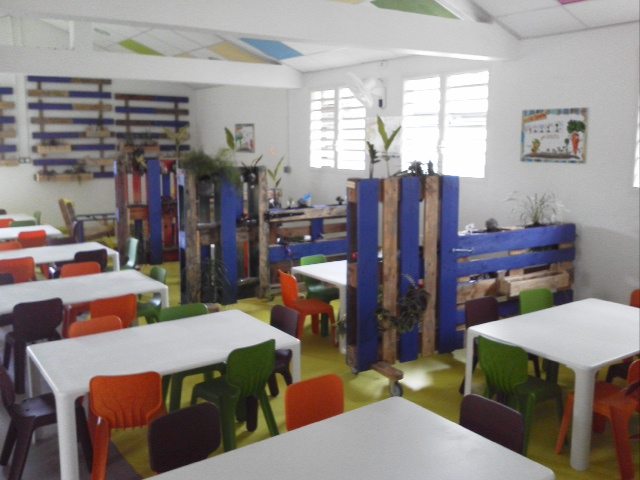
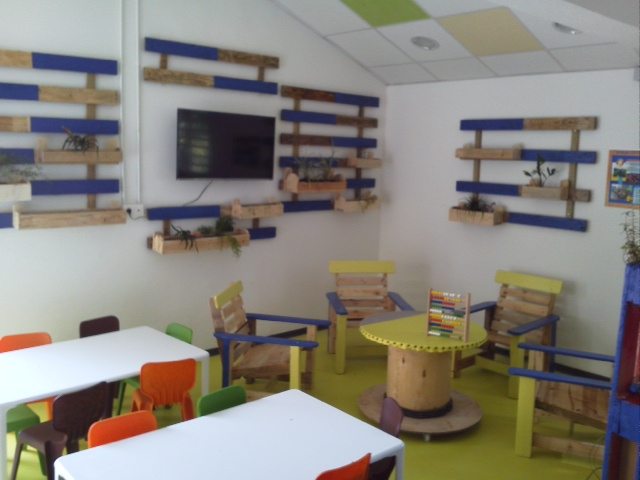
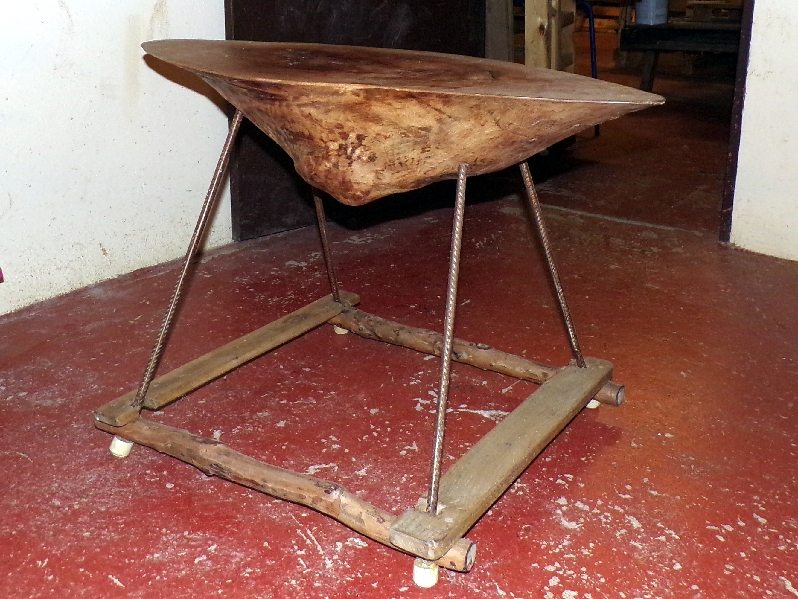
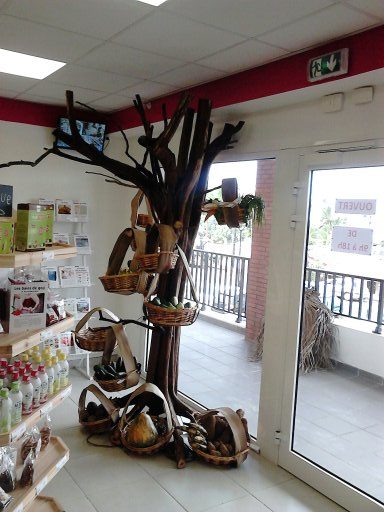
Since we’re always on the lookout for bio-based materials, we recycle wooden pallets to build furniture. What sets our designs apart—and distinguishes us in the market—is that we do this using as little fossil fuel as possible, that is, through permaculture. We prioritize the use of recycled nails from the wooden pallets and use as few screws as possible. We try to minimize the time spent on sanding and finishing to avoid a large carbon footprint, and we source the wooden pallets from areas near our workshop. We design our furniture based on the availability of wood, which requires our eco-technician to use creativity and imagination to build the piece the customer needs—regardless of the type of wood—as well as a solid grasp of mathematics.
We also offer guided woodworking classes. In these classes, participants come to the workshop, and we help them build the piece of furniture of their choice over the course of three hours.
Who can buy the furniture you make?
Anyone can buy our furniture—both private individuals and public entities. We manufacture everything to order. We can replicate any piece of furniture that exists. Most often, we ask our customers to find something online that they like and need, and we reproduce it. And if the furniture breaks, just give us a call and we’ll come repair it.

Do you have any suppliers?
There are two types of wooden pallets: the «European» pallet, which is returnable, and the «disposable» pallet, which is not subject to any regulations. With disposable pallets, we have suppliers who provide us with good-quality wood in useful sizes. We also collect the first planks of wood from sawmills in Martinique—known as «la croûte»—to make various pieces of furniture.
How many employees work at MétaSystème?
MétaSystème is a worker-owned cooperative (SCOP) run by a core team of three co-managers and a number of young people who are not directly employed by the organization. We employ young adults, take on interns, and sometimes, on construction sites, we have to temporarily hire young people. What interests us most is being able to replicate our model. We want to show that this model is feasible in every middle school in Martinique. There are more than 40 middle schools in Martinique, so there’s room for quite a few teams.
Do you have any future plans?
With the fundamentals, concepts, and systems we use, it would be interesting for us to work on much larger areas. For example, when it comes to urban gardening, we rely heavily on permaculture. This new type of agriculture needs to be adapted to Martinique because it is chlordecone-free. We’re tackling this issue head-on by educating people about different ways to grow crops—but without soil.
Interview by Mariska Desmarquis





Contact: j.lagrandcourt@metasystemes.com
Phone: 0696 01 00 66
Facebook: https://www.facebook.com/pg/metasystemes/about/?ref=page_internal