
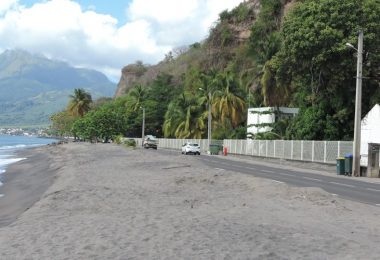
The Town of Le Carbet Faces Climate Change: From the Coastline to the Pitons, the Challenges of a New Relationship with the Land.
Cyclonic swells and rising sea levels are natural forces that are now prompting us to rethink our relationship with the coastline. Having undergone significant urbanization in recent years, the coastline is increasingly under threat. It is against this backdrop that the DEAL of Martinique and the city of Le Carbet have partnered with the DSA architect-urban planner to explore short- and long-term development strategies that will help address the challenges of settlement in the context of climate change. Following the DSA studies conducted in Le Prêcheur and Trinité, this study constitutes the third Martinique-based component of the «Imagining Tomorrow’s Coastline» initiative launched by the Urban Planning, Construction, and Architecture Plan (PUCA).
Building on this initial issue, the study seeks to develop positive solutions that can highlight the untapped resources of Le Carbet. Based on a forward-looking vision extending to the year 2100, it aims to reveal possible futures in order to set in motion, starting today, a development process that is both virtuous and sustainable.
On November 6, students from the Marne-la-Vallée School of Architecture (Julien DOMINGUE, Valentin KOTTELAT, and Mado RABBAT) presented their work to the public. More than sixty people came to learn about the solutions proposed by this study to address natural erosion and rising sea levels in the coming decades. Throughout the presentation, the audience was able to gauge the impact of this natural phenomenon on coastal homes. Clearly, the scenario of the sea encroaching inland is inevitable. The challenge today is to adapt to natural hazards and to consider the transformation of the coastline and the relocation of certain populations. The projects presented prompted the audience to respond, particularly regarding the issue of Carbet’s urban planning in the years to come.
The study proposes solutions that build on existing conditions and respect local ways of living, land use, and resource management. These proposals reveal a vision that is both resource-efficient and positive. They seek to improve residents« quality of life while taking a slight »step aside.”.
This study does not present a rigid, long-term project plan, but rather a flexible and adaptable approach that should be open to new ideas and lead to sound land-use planning.
Source: http://www.villeducarbet.fr/services-municipaux/urbanisme/?fbclid=IwAR0ZaftNPFLrLj_2doRoBVXtynH5iK4iKcDJm31HFARpJHD9aTIilMk1PGc