
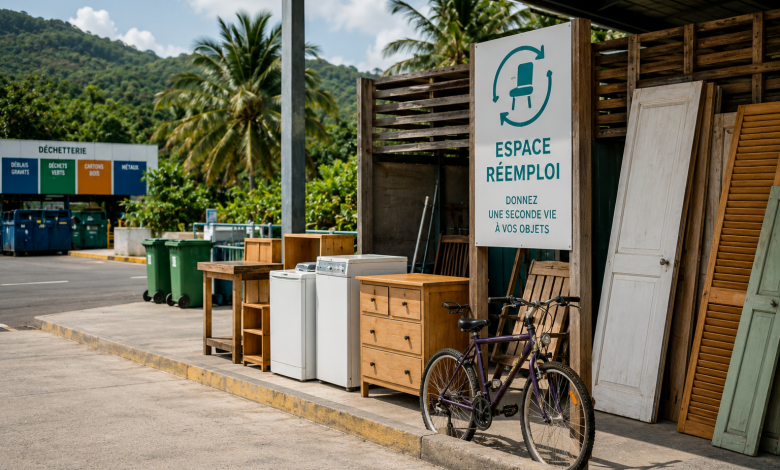
Giving a second life to a piece of furniture, a household appliance, a garment, or a building material is no longer just an individual act. In France, reuse is gradually establishing itself as a pillar of public policies for the circular economy. Financial support, new requirements for extended producer responsibility (EPR) schemes, the expansion of reuse areas at recycling centers, and changes in public procurement: the tools to promote more sustainable product use are multiplying.
The second annual report from the Observatory on Reuse and Recycling, published by ADEME based on 2024 data, reflects this growing trend. For Martinique, the report also provides an initial overview of the territory’s role in this national trend, while highlighting the room for improvement that still exists.
A public policy that is gradually gaining momentum
For a long time, it was driven primarily by the social and solidarity economy organizations (ESS), the reuse sector now benefits from an increasingly structured regulatory framework. Since the law on waste reduction and the circular economy (AGEC), several measures are aimed at boosting both the supply and demand for reused products.
In 2024, ten REP programs are now subject to reuse or recycling targets. The requirements are no longer limited to waste management.
They also address the financing of operators, the creation of collection systems, the establishment of designated areas at recycling centers, the development of monitoring studies, and the integration of reuse into public procurement.
This development reflects a shift in thinking: Extending the lifespan of products is gradually becoming a key driver in the transition to a more circular economy.
Indicators Showing Significant Improvement
Initial results indicate that the sector is gradually becoming more structured.
Approximately 2,100 facilities Initiatives related to reuse and recycling, in collaboration with environmental organizations, were identified in 2024.
Their numbers are increasing by 70 % compared to the previous year, a trend that reflects both the expansion of partnerships between environmental organizations and operators and an improvement in statistical tracking. More than 60 % Some of these organizations are part of the social and solidarity economy.
Traded volumes are also on the rise. Nearly 100,000 metric tons Products were effectively reused or recycled in 2024 across major consumer sectors, including electrical and electronic equipment, furniture, textiles, toys, and sports and DIY items.
At the same time, nearly 120,000 metric tons Additional materials were prepared for reuse.
To support this initiative, environmental organizations have contributed 43 million euros financial support for organizations involved in reuse in 2024, including 35.5 million euros from funds earmarked for reuse. In addition, ADEME has committed 6.5 million euros through its Circular Economy Fund to finance 55 projects.
These figures reflect growing government investment in the development of this sector.
Martinique is still underrepresented
In addition to the national data, the report provides an initial overview of the situation in the overseas territories.
The mapping conducted for the main consumption sectors identifies five facilities in Martinique that have reported reuse activities to environmental organizations.
By way of comparison, Guadeloupe has two, French Guiana has three, and Réunion has nine. Some overseas territories, such as Mayotte, Saint Barthélemy, Saint Martin, and Saint Pierre and Miquelon, have none within the study area.
However, these data should be interpreted with caution.
The report does not list all secondhand businesses operating in the regions. It covers only those organizations that have agreements with environmental organizations and have reported their operations in the six relevant sectors.
Secondhand dealers, peer-to-peer sales platforms, certain consignment shops, and informal donations are therefore not included in these statistics.
The number of organizations identified therefore does not reflect the full extent of the reuse sector in Martinique, but rather constitutes an indicator of the sector’s current structure within the framework of national public policies.
Several avenues still need to be explored
The report also highlights several tools that could accelerate the growth of reuse in local communities.
The first one concerns the recycling centers. In 2023, 74 % of the surveyed local governments had already set up at least one reuse area to collect items that are still usable before they become waste. These spaces then facilitate their transfer to specialized organizations.
Another lever: public procurement.
Since the AGEC Act, the federal government, local governments, and their associations must include a certain percentage of products derived from reuse, repurposing, or containing recycled materials in their purchases, at rates ranging from 20 % to 100 % depending on the categories of property involved. The requirements were clarified by a new decree issued in 2024.
Funding is also a major driving force. Funds dedicated to reuse primarily support organizations in the social and solidarity economy, which account for more than 95 % funding allocated to the relevant sectors.
Finally, several sectors stand out as particularly strategic: electrical and electronic equipment, textiles, furniture, and construction materials, for which reuse volumes are gradually increasing, even though several sectors are still far from meeting their targets.
A dynamic that is still taking shape
ADEME emphasizes, however, that these results are, above all, a initial assessment. These programs are still relatively new, and several sectors remain insufficiently structured to achieve the set objectives.
The report also notes that the available data covers only a portion of the actual reuse activities in France, as the material flows tracked by environmental organizations represent only a fraction of the transactions actually carried out.
For an island territory like Martinique, where waste management, import costs, and resource conservation are major challenges, The growth of the reuse sector goes beyond just environmental concerns.
It can also help strengthen the local economy, support social and solidarity economy organizations, and extend the lifespan of assets already present in the area.
The national assessment shows that the necessary tools are beginning to be put in place. The question now is how these mechanisms can be fully leveraged to support the development of a genuine reuse sector on a Martinique-wide scale.
Click on the image to download the REPORT