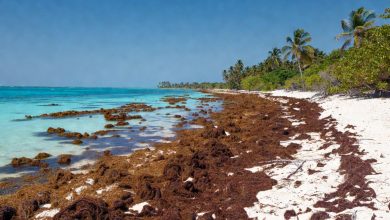

The buildup of Sargassum seaweed poses a real danger to local communities. Everyone is offering their own ideas to find a solution to this problem. In fact, many internet users have been sharing a video of a floating barrier in Punta Cana, Dominican Republic. This solution was proposed by the company Ris’k; here’s an interview with its deputy director, Michel Pastour.
What solutions has Ris’k implemented to combat Sargassum?
We are proposing a concept that involves installing anti-Sargassum barriers and providing a flat-bottomed barge capable of collecting Sargassum out at sea. These two solutions can be used together to optimize efforts to combat Sargassum.
What are the advantages of this system?
The barrier keeps the Sargassum out at sea, far from the coast, thereby preventing the algae from decomposing and avoiding the harmful problems that result from it. The barge allows for collection at sea and also prevents large patches of Sargassum from reaching populated areas.
Is this suitable for all websites?
The challenge with our coastlines is that they’re all different, and installing or using a barge requires an assessment of wind, swell, seabed conditions, and potential anchor points to determine the best solutions for anchoring and ensuring the barrier remains sturdy against currents, winds, severe weather, or even the weight of Sargassum. Studies are conducted beforehand—it’s not just a simple matter of installing a barrier like you would on land; there are various factors to take into account.
What are the characteristics of the dam?
The dam itself is a floating tube that is moored and secured to the bottom by various means, such as mooring blocks (large concrete blocks) or anchors… It all depends on the seabed survey, which will determine the appropriate type of anchoring that can withstand the various forces of nature.
Could this have an environmental impact on the marine ecosystem?
The idea is that our solution will have very little impact on the marine environment. We work with certified divers who operate in a way that respects the environment, and that’s our motivation as well. Our company is committed to offering environmentally friendly solutions. The barrier will block the seaweed, but fish can pass underneath it.
Have you ever had the opportunity to conduct experiments?
Yes, we did one at Le Marigot a while back. We identified areas for improvement and the positives. The idea is to use that as a basis to better position ourselves and offer solutions that are even better suited to our needs.
Have you ever been approached by individuals or local governments?
Right now, everyone is asking for our help, but there’s no point in rushing. We need to plan ahead and come up with a solution, which takes time. We need to conduct a study to make sure we do things right and in a sustainable way so that it works.
How many metric tons of sargassum can the barge collect?
There are different models and sizes of barges, and this affects the amount of sargassum collected. Some can collect up to 80 metric tons per day—though these are the larger barges—while the smaller ones can collect up to 20 metric tons per day. Here, too, a study is needed, as we’ll determine the appropriate barge based on the seabed conditions.
How did you come up with this idea?
We work with long-standing partners, and we already specialize in environmental protection through the provision of oil booms—that is, anything related to hydrocarbons or pollution caused by human waste. Faced with the problem of Sargassum, we worked with our partners to adapt this solution.
Interviews conducted by Kaylan Fagour