
In Martinique, 22 % among adults aged 18 to 64, or about 44,000 people, face significant challenges with basic skills. This finding, highlighted in the third issue of the Key Figures from the National Observatory on Illiteracy and Digital Illiteracy (ANLCI) goes far beyond the issue of illiteracy alone.
It highlights a human development issue that directly affects employment, digital inclusion, training, and, more broadly, the region’s ability to meet the challenges of the coming decades.
Basic skills include the ability to read, write, understand text, perform basic math, and use digital tools. Today, they form an essential foundation for accessing employment, pursuing training, completing administrative tasks online, and adapting to changes in the world of work. According to the ANLCI, nearly one in five adults in Martinique has significant difficulties in at least one of these areas.
Challenges that go far beyond illiteracy
The study shows that the situations encountered are diverse. If 13 % for Adults experience difficulties with writing; more than one in two actually fall into the category of functional illiteracy, while other situations involve a lack of confidence with written language, allophony, or even illiteracy. A fact that is often overlooked is that, 83 % of people experiencing illiteracy have, however, attended school in France, noting that these difficulties can arise even in students who have followed a traditional academic path.
The survey also highlights significant difficulties with math. Approximately 20 % for adults, or nearly 38,500 people, have difficulty with numeracy, whereas 8 % have significant literacy difficulties. These data show that mastery of basic skills is not limited to reading and writing, but encompasses all the knowledge necessary for independence in daily life.
A Visible Impact on Employment, Income, and Digital Technology
The results highlight a close link between basic skills and living conditions.
Unemployed people are more affected: 28 % Some of them face significant difficulties with basic skills, whereas 19 % people who are employed. However, these challenges do not affect only those who are far from the labor market. More than half of the adults in question are already employed, which serves as a reminder that upskilling is also a key issue for employees.
The disparities are just as pronounced when broken down by educational attainment and income. Nearly one in two people without a degree is in serious difficulty, compared with only 10 % of those with a high school diploma or higher degree. Similarly, among the 40 % of the population with the lowest incomes, 34 % face significant difficulties with basic skills. Residents of priority neighborhoods under the urban policy are also more affected, with a rate of 30 %, versus 22 % outside these neighborhoods.
Digital technology is another telling indicator. Among adults facing significant difficulties, 54 % use the Internet every day, versus 85 % people who do not face these challenges. At a time when many public services, administrative procedures, and training programs are moving online, this difference highlights the importance of basic digital skills in accessing digital services.
A Challenge in Supporting Martinique's Transitions
Beyond the statistical findings, this publication serves as a reminder that basic skills have become a key factor in supporting major transformations in the region. The digital transition, changes in the workforce, skills development, access to digital services, and the adaptation of businesses—all of these developments depend on residents’ ability to master fundamental skills.
The ANLCI also points out that Martinique has 2.2 times as many people with significant difficulties in basic skills as in mainland France, a gap that highlights the importance of the prevention, training, and support initiatives already underway in the region.
Through this publication, the Observatory on Illiteracy and Digital Illiteracy provides a valuable overview for local governments, businesses, training organizations, and all stakeholders involved in human development. For while the transitions of tomorrow require investment, they rely just as much on the skills of those who will shape Martinique in 2050.
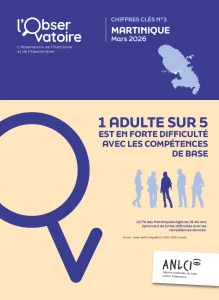
FOLLOW THIS LINK TO DOWNLOAD THE DOCUMENT: https://www.anlci.gouv.fr/ressources/chiffres-cles-martinique-2026/