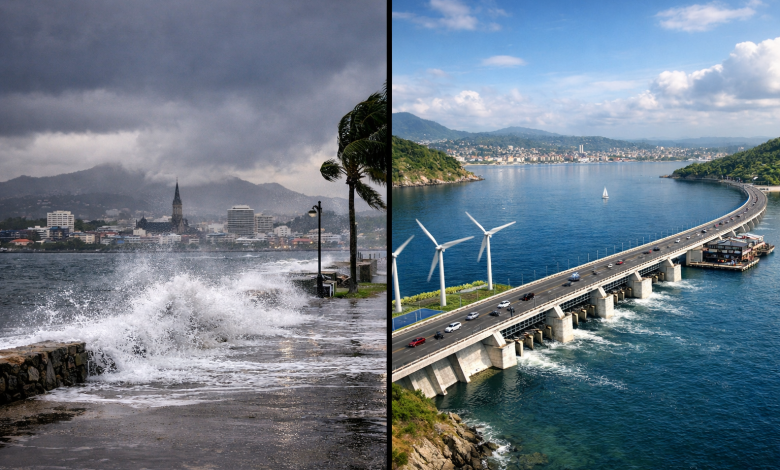
Florent Grabin, president of the environmental organization PUMA, is calling for greater awareness of the risks associated with global warming and rising sea levels in Martinique. In the wake of the municipal elections, he believes these issues have received too little attention in the public debate. He is now calling for an in-depth discussion on land-use planning, the protection of Fort-de-France Bay, and the need to immediately launch studies on large-scale solutions.
«What’s at stake isn’t just the coastline: it’s the very future of Martinique’s strategic areas.»
Now that the municipal elections are over, what are your thoughts?
The campaign is now over, with the end of public loudspeaker announcements, and as is often the case, every promise has been made. Everyone had their own catchphrase, criticism, or “stink bomb,” but in the end, I note once again that the big winner is still voter abstention, which, in my view, reflects the many disappointments caused by the behavior of many elected officials. This inevitably raises questions about how we practice democracy at the local level.
The political landscape has changed: some mayors were re-elected, while others were newly elected. PUMA welcomes them and, above all, wishes them success in implementing their programs. But I deeply regret that the environment, global warming, and rising sea levels were virtually absent from the various debates. Yet these are major issues. We will continue to advocate—with the support of the public—to ensure that those in positions of responsibility finally take all necessary steps to address this predictable and inevitable change.
Why do you say that these issues have not been adequately addressed?
Because we can no longer pretend that these issues are a thing of the distant future. Sea levels are rising inexorably across the globe. Scientists are documenting this. We know that the effects of global warming will directly impact coastlines, low-lying areas, farmland, infrastructure, equipment, and populated areas.
I think we’ve fallen far behind. Martinique is already lagging significantly in several key areas: water and sanitation, the road network, water reserves for drinking and agriculture, and public housing, among others. In this context, rising sea levels should not be viewed as just another issue among many, but as an aggravating factor that requires us to rethink land-use planning.
You mention the need to go into detail at the level of coastal municipalities. Why?
Because the risk is not abstract. It directly affects municipalities, neighborhoods, land, and economic activities. It also requires that public officials at all levels take this issue seriously. In my view, we need to move beyond overly general approaches and take a concrete look at what threatens coastal communities, their infrastructure, their fertile land, and their utility networks.
I sometimes feel that this issue, though fundamental to land-use planning, is not given the priority it deserves. I don’t want to make this debate overly personal, but I believe that everyone who currently holds or has held positions of responsibility in land-use planning, major public works, infrastructure, transportation, natural hazards, or sustainable development should play a much more visible role in bringing this issue into the public discourse.
Why do you place so much emphasis on the Bay of Fort-de-France?
Because this is an urgent matter. All strategic infrastructure is located in the Bay of Fort-de-France: the port, the airport, EDF, industrial zones, residential areas, and essential utility networks. If this low-lying part of the territory is severely affected, the entire island of Martinique will be left vulnerable.
That is why I am asking a simple question: When will feasibility studies be launched to protect this low-lying part of Martinique from rising sea levels? During some discussions with government agencies, we were told that it would be up to the federal government to conduct these in-depth studies and carry out this work. Yet, at the same time, many local officials are calling for more power and responsibility. This is a real paradox. When it comes to the redevelopment and protection of Martinique, now is precisely the time to show that we are capable of acting in the public interest.
«We cannot demand more responsibility and, at the same time, keep leaving it up to others to take action on such a vital issue.»
You are proposing the construction of a dam. Where exactly would it be located?
The dam I am proposing would be located offshore from the bay, between Anses-d’Arlet and Fond Lahaye. In my opinion, this is the most appropriate location for ensuring comprehensive protection.
I would add that, a very long time ago, this boundary did exist. It was an ancient landslide that altered the landscape of this area and gave rise to the Bay of Fort-de-France as we know it today. This fuels my reflection on how to think about this territory over the long term.
With future storm surges, experts say we will have to anticipate wave heights of more than 30 meters, which will inevitably cause extensive damage throughout the lower-lying areas of this coastline. One need only imagine what this means to realize that we can no longer afford to simply wait.
On what grounds do you support such a proposal?
I draw primarily on the IPCC’s studies, which are very well-documented. I also draw on the meetings and discussions I’ve had over the years. Climatologist Jean Jouzel, whom I met in Paris and who honored us with a visit in January 2018, drew my attention to the threat posed to the bay by rising sea levels.
I have been interested in the topic of redevelopment for more than twenty years. In my view, this should be the bible for our decision-makers. Unfortunately, we are still a long way from achieving a level of awareness that does justice to this natural reality.
In your opinion, what would be the benefits of such a book?
The primary benefit is, of course, protection. The decision to choose the Fort-de-France Bay is urgent because it is home to all of Martinique’s strategic points. There is therefore a major interest in protecting this area.
Furthermore, a project of this scale would generate significant activity in the construction industry, which is in great need of it. We have engineers capable of responding to requests for feasibility studies from our local governments. This is also true of the vast majority of companies that possess expertise and could share it, including by opening up to the rest of the Caribbean. All too often, the lack of public contracts has stifled momentum and left many professionals in a state of uncertainty or fear. Yet behind this type of project lies the economic and social future of Martinique.
A protective dam can offer many benefits. I’m thinking of the possibility of installing pumps coupled with turbines to generate electricity, setting up solar panels, building a road connecting the two banks, or even developing a new tourism industry with floating hotels and restaurants.
It would also be possible to clean up the watershed between the dam and the landward side, with a view to establishing an aquaculture farm and mobile structures. In my view, this project is not limited to a defensive structure; it is part of a broader vision for the future and the redevelopment of the region.

You also mention the “salted bevel.” Why is this an important point?
Because the massive influx of seawater can cause salt intrusion into coastal farmland, particularly in towns such as Les Trois-Îlets, Rivière-Salée, Ducos, and Le Lamentin. Yet this land is very fertile, and we must protect it at all costs.
It’s not just farmland that’s at risk. It’s also all the buildings, the entire water and sewer system, as well as the electrical and telecommunications networks. So when we talk about rising sea levels, we’re not just talking about a receding coastline. We’re talking about foundations, vital infrastructure, the economy, safety, and everyday life.
What constraints or limitations do you see with such a project?
There are, of course, technical, environmental, and financial constraints. On this topic, we consulted Serge Capgras, president of COBATI, as well as Paul-Louis Bourrioullou, our consulting geologist. We also acknowledge the DEAL and the BRGM.
From an environmental standpoint, I believe the project would help preserve the area’s mangrove forest and prevent excessive salinity, which is highly detrimental to agricultural production, building foundations, and water, sewer, electricity, and communications systems.
From a technical standpoint, there is a huge need for rockfill material. In my opinion, it could be extracted from underground—where it would also be essential to dig tunnels to allow traffic to flow in certain areas.
As for the cost, we should expect it to be between 4 and 5 billion euros. That is a considerable amount, of course. But it is precisely because this is such a large-scale project that we need to open the debate now, rather than wait until we are caught off guard by the pressure.

Would you like this project to be launched immediately?
First, I believe that certain proposals must be made public, because they will inevitably spark important debates that will need to be resolved quickly. My goal is not to pretend that everything has already been settled, nor to suggest that a simple document is enough. I want the public to be kept informed with factual information, for the debate to be properly framed, for a dialogue to begin, and for decision-makers to stop ignoring what is coming.
This project, as we have described it, is subject to the prior consultation process set forth in Article L 300-2 of the Urban Planning Code. This clearly means that we are not talking about forcing the issue through, but rather about a matter that must be addressed collectively.
What role does PUMA intend to play in this debate?
PUMA is working to raise public awareness. We believe it is our duty to keep the public informed with factual information in order to protect Martinique and all its communities. In addition to the scientific community’s findings—which continue to document the effects of rising sea levels—elected officials must also take a clear stance on this issue.
For us, it’s about continuing this work of raising awareness, over and over again. This issue will profoundly change our lives in the coming years. We cannot pretend that it doesn’t concern us. It’s up to us to keep raising awareness so that Martinique can be different.
Interview by Philippe PIED