Between 2019 and 2025, average coral cover decreased by 61 % at the five monitoring stations in Martinique that are part of the GCRMN network. This trend shows that reef degradation is not limited to the two bleaching events that occurred in 2023 and 2024. It is part of a longer-term trend marked by the accumulation of several successive pressures.
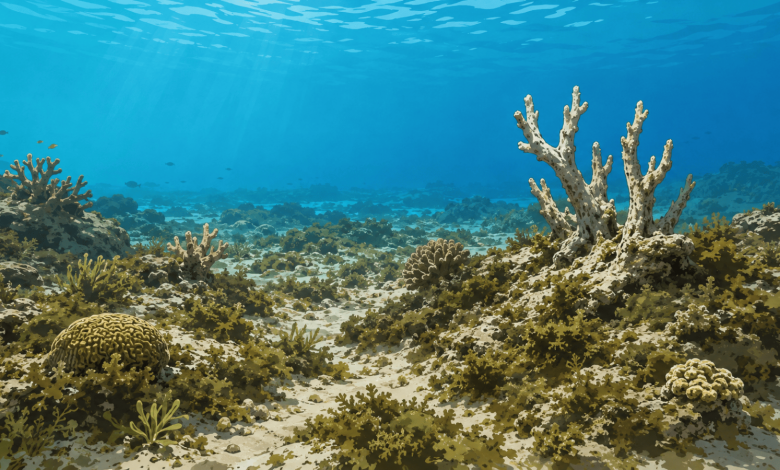
In 2025, the benthic communities observed at these stations are dominated by algal communities. Three sites then have coral cover of less than 5,5 %, indicating a particularly advanced decline in coral cover in part of the monitored area.
A process of weakening that began before the marine heat waves
Martinique’s reefs were already weakened before the bleaching events of 2023 and 2024. The report published by IFRECOR links the observed trend to several phenomena, notably the hard coral tissue loss disease, known as SCTLD, which occurred between 2019 and 2023.
This disease preceded the two marine heatwaves that subsequently caused massive bleaching events in the French West Indies. As a result, the corals were subjected to a series of disturbances, without any truly prolonged period of respite.
Coral bleaching occurs when abnormally high sea temperatures cause stress in corals. But in the case of Martinique, the recent bleaching events did not occur on undamaged reefs. They affected communities that had already been facing several years of degradation.
The report remains cautious about causal links and notes that the observed decline may be associated with the cumulative effect of coral diseases and successive bleaching events. However, it highlights a continuity between the decline that began in 2019 and the condition observed in 2025.
In 2025, algae are gaining ground
The decline in coral cover does not merely result in the disappearance of colonies. It also alters the composition of the seafloor.
At the five stations in Martinique monitored as part of the GCRMN network, algal communities now dominate the benthic communities. This trend reflects a shift in the ecological balance: as coral cover declines, algae are occupying a larger share of the available surface area.
Three stations have coral cover of less than 5.5 %. While these levels do not represent all of the island’s reefs, they provide an accurate indication of the condition of the sites included in the monitoring program.
Across the French West Indies, the report also notes that some sites will have coral cover below 5 % in 2025—the lowest levels recorded since observations began. Martinique is thus part of a broader trend of degradation in the archipelago’s reef communities.
There are no signs yet of a return to previous levels
The report does not claim that Martinique’s reefs are permanently incapable of recovering. However, the available data show that, as of 2025, no return to the coverage levels observed before the recent crises is yet visible at the monitoring sites in question.
The succession of stressors is complicating the recovery. After several years marked by coral diseases, the 2023 bleaching event was followed the very next year by another episode, which was more intense across the Caribbean and lasted nearly four months.
This recurrence reduces the time communities have to stabilize between disturbances. It also occurs in a context where coral cover is already low and algal communities have become dominant at several sites.
The results observed between 2019 and 2025 therefore no longer reflect solely the consequences of two exceptional events. They reflect a long-term decline, driven by successive pressures and the absence, at this stage, of any visible recovery at the monitored sites.
By 2025, the slow rate of coral recovery and the spread of algae indicate that the balance of the reefs has changed profoundly. The issue is no longer simply a matter of measuring losses after each event, but of monitoring whether or not these ecosystems are able to return to a path of recovery.