The coastline is one of Martinique’s most valuable areas. It is home to economic activities, infrastructure, public facilities, residential areas, and a large portion of the island’s tourism industry. Yet these areas are also among the most vulnerable to the effects of climate change.
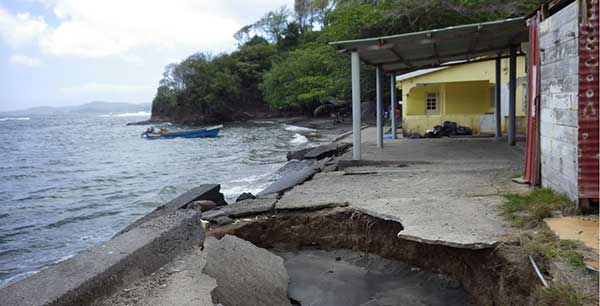
As a result of coastal erosion, storms, swells, and gradual sea-level rise, certain sections of the coastline are already changing. In light of this reality, public policies now seek to better anticipate future changes. The Green Fund 2026 is part of this effort, offering several tools designed to support local governments facing coastal retreat.
A natural phenomenon exacerbated by climate change
The coastline refers to the boundary between land and sea. Contrary to popular belief, this boundary is not fixed. It changes naturally due to ocean currents, swells, storms, and sand movement.
Climate change, however, tends to exacerbate these phenomena. Rising sea levels and the intensification of certain weather events are contributing to accelerated erosion in certain coastal areas, both in mainland France and in its overseas territories.
For island regions, this trend raises many questions. Beyond the gradual disappearance of certain beaches, erosion can affect roads, infrastructure, public facilities, and even economic activities located near the coastline.
Understand the Risk Better to Take Better Action
In light of these challenges, local governments are increasingly being encouraged to develop a detailed understanding of changes to their coastlines.
The Green Fund’s guidance document on coastal retreat thus provides for funding to conduct studies, collect data, and develop monitoring tools to better understand erosion dynamics.
In particular, this research can provide data for coastal monitoring networks, generate exposure maps, and identify the most vulnerable areas.
This fact-finding phase is often an essential step before any planning decision is made. It provides local governments with objective information to guide their public policies and prioritize the actions to be taken.
Anticipating Changes in Coastal Areas
One of the key trends in public policy today is a shift toward proactive planning rather than reacting to emergencies.
The Green Fund thus supports the development of local strategies for adapting to coastal retreat. These initiatives enable local governments to take a long-term view of the potential consequences of erosion in their areas.
Discussions may focus on the evolution of urbanized areas, the adaptation of existing infrastructure, or the preservation of certain natural areas that are particularly vulnerable.
The goal is not to predict the future of the coastline with certainty, but to prepare regions for several possible scenarios in order to reduce their vulnerability to future changes.
A challenge that is as much about land use planning as it is about the environment
Long viewed as primarily an environmental issue, coastal erosion is now considered a major land-use planning challenge.
The 2021 Climate and Resilience Act also introduced new tools designed to help local governments incorporate this issue into their urban planning policies and development projects.
The Green Fund is helping to drive this change by supporting not only local studies and strategies, but also certain initiatives aimed at territorial restructuring. The goal is to enable coastal regions to adapt gradually rather than suffer the consequences of erosion once they become too severe.
For Martinique, where the coastline plays a central role in economic, social, and tourism life, this ability to anticipate future developments is increasingly seen as a key element of regional resilience.
Preparing Today for the Coastline of Tomorrow
Coastal erosion is not merely an environmental challenge. It also raises questions about land-use planning, economic development, and the future organization of coastal regions.
By supporting local governments in building knowledge, planning, and adapting their projects, the Green Fund is helping to foster a more preventive approach to coastal management. This development could play an important role in the ability of Martinican communities to cope with climate change over the coming decades.