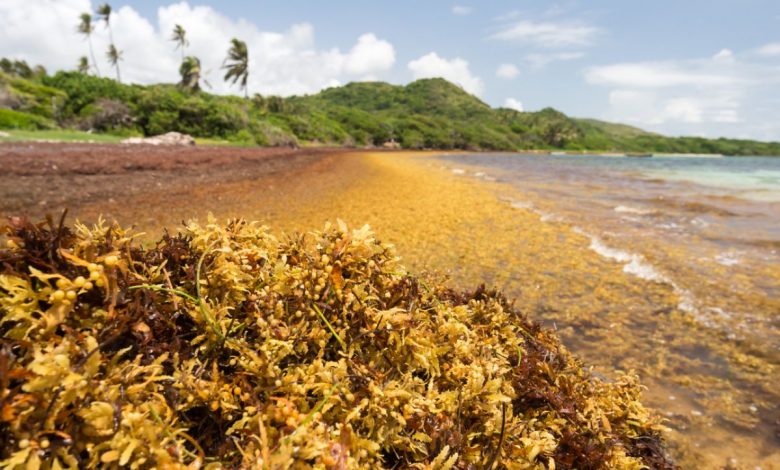
From September 28 to 30, Cancún, Mexico, will host the Sargassum Cooperation Days. Government officials, scientists, businesses, and international organizations from the Caribbean—including Martinique—will gather there to compare their methods for predicting strandings, collecting the algae, finding ways to utilize it, and minimizing its impact on ecosystems.
Three programs behind the event
The events bring together several regional initiatives. SARG’COOP II, an INTERREG Caribbean program led by the Guadeloupe Region, organizes cooperation around six areas: governance, networking, collection and utilization, monitoring, impacts and biodiversity, and advocacy.
 SARSEA, funded by the French Development Agency (AFD) and implemented by Expertise France, aims to mitigate the effects of Sargassum on coastal ecosystems and local economies, and to strengthen regional management capacities. CARIBS, launched by the Équipe France Fund, focuses on satellite monitoring, the industrial use of seaweed, and public education. Its official launch is scheduled for September 29.
Seated around the table: Martinique, Guadeloupe, Saint Martin, Mexico, Cuba, the Dominican Republic, and other Caribbean partners.
From the Mexican countryside to regional governance
The program kicks off on September 28 and 29 with a field visit to the state of Quintana Roo to observe Mexican models of collection and recycling that could be adapted elsewhere in the Caribbean. On the 29th, a technical workshop will focus on the safe storage of sargassum and on health and environmental standards.
On September 29 and 30, a regional governance lab—the «Regional Sargassum Governance Policy Lab»—will bring together about 50 representatives from states, territories, regional organizations, scientists, and international partners. Based on the challenges and needs expressed by each territory, they will identify priorities and joint actions.
These events take place ahead of the fourth Global Gateway conference between the European Union and the Caribbean, on October 1 and 2.
Anticipate, Protect, Prevent
Three projects already underway are presented here. The first, led by CLS—a company that has specialized in Earth observation since 1986—is rolling out a satellite-based service to monitor and forecast Sargassum blooms, to help local authorities prepare their response efforts before the algae arrive. Since 2018, CLS has been developing SAMTool, a tool for monitoring algal blooms.
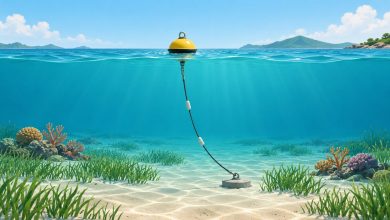
The second project, SABER, led by Sorbonne University as part of SARSEA, measures the effectiveness of sargassum barriers in Martinique and Guadeloupe, as well as their effects on coastal ecosystems.
The third comes from Mexico. The Universidad Autónoma de Yucatán is studying the risks associated with algae decomposition—particularly gas emissions—and developing decision-support tools.
What Martinique Expects
The organizers point out that Sargassum seaweed washes up on the coast of Martinique repeatedly and in large quantities, with consequences for tourism, fishing, and public health. For the island, these exchanges should provide access to techniques for collecting the seaweed at sea and recycling it, and allow the island to share the cost of research with other islands.
Martinique is represented there by several experts who have been following the issue for years.
Philippe Pied