As of January 1, 2026, recycling guidelines have changed in Martinique. All packaging and paper can now be placed in the yellow bins or collection stations, including yogurt containers, plastic wrap, and certain food trays that were previously excluded. However, once collected, this waste is not entirely processed on the island. Martinique has adopted a transitional arrangement through 2030, under which part of the sorting is done locally before the waste is shipped to Europe.
Simplified recycling since January 2026
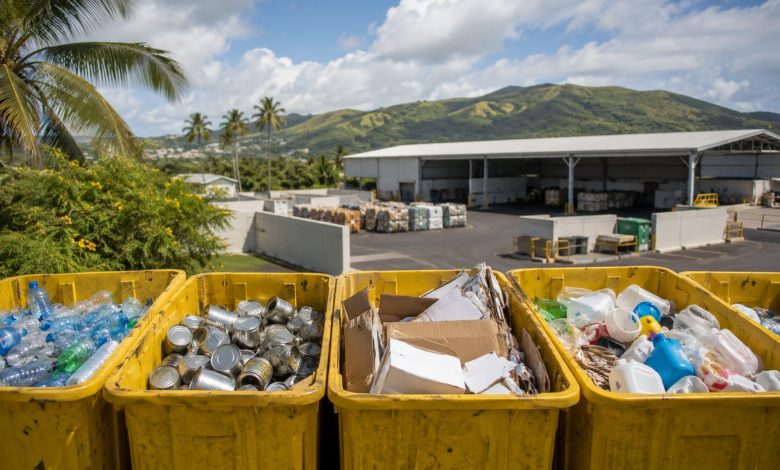
Since the beginning of the year, the expansion of recycling guidelines has affected the’all packaging and paper. Plastic bottles and containers, metal packaging, cardboard boxes, as well as yogurt containers, plastic wrap, and food trays can now be placed in the same recycling bin.
The goal is to increase the amount of recyclable materials collected and to gain a better understanding of available sources. This is particularly important in the overseas territories, where collection volumes remain lower than those in mainland France.
ADEME reports that in 2023, the average amount of packaging collected reached 23.1 kg per capita in the overseas territories, compared with 73.9 kg per capita in mainland France. However, this figure is an average for the overseas territories and does not specifically apply to Martinique.
A transitional solution through 2030
To support this development, Martinique has decided to modernize its existing sorting center rather than immediately building a new facility.
According to ADEME, this solution should make it possible to track the actual changes in the volumes collected following the expansion of the deposit-return program. Operational since January 2026, the center is expected to process various waste streams through 2030, including fibrous materials, steel, aluminum, and both rigid and flexible plastics.
This period should be used to identify the region's future needs. An increase in the amount of waste deposited in the yellow bins can, in fact, affect the organization of the entire process, from collection to processing.
Martinique’s approach, therefore, is—for now—one of adaptation: making the most of existing facilities while assessing the practical impact of the new guidelines before deciding on a more substantial investment.
Sorting continues outside of Martinique
The stop at the Martinique center is not the final step. After this initial processing, the shipments must be routed to a re-sorting center in Europe, according to ADEME.
This arrangement illustrates one of the recurring challenges of waste management in overseas territories. The volumes of waste generated on a single island may be too small to justify the construction of certain specialized facilities.
Added to this are geographical distance, transportation constraints, and a level of equipment that does not always allow for the local processing of all materials.
The ADEME Magazine more broadly emphasizes that small landfills are one of the main obstacles to the development of local waste management systems for waste covered by extended producer responsibility.
In many cases, the materials still need to be exported to France or other countries before they can be recycled or reused.
For Martinique, therefore, the expansion of recycling alone does not solve the issue of what to do with packaging. It does, however, make it possible to better identify available quantities and determine whether local solutions can become technically and economically viable.
Will new equipment be needed after 2030?
That is precisely one of the questions that will need to be answered in the coming years. A study funded by ADEME is currently underway in order to inform the traffic management strategy beyond 2030 and assess the need to build a new facility.
The publication does not specify the timeline for this study, its cost, or the capacity that a potential future center might have. Therefore, no definitive scenario is presented at this stage.
Changes in the volume of materials collected will be a key factor. ADEME also points out that the first collections following the expansion of the return programs should enable local authorities to assess whether the current systems are adequate.
Depending on the results, several changes may be considered: increasing the capacity of the bins, adjusting the frequency of collection routes, or increasing the density of recycling drop-off stations.
2026: A Year of Observation
The new recycling guidelines thus specify the beginning of a broader phase of adaptation. The challenge will not only be to collect more, but also to accurately determine the nature and volume of the recovered materials in order to build a sustainable system.
Martinique has a transitional solution in place through 2030. At that time, the region will need to decide whether the volumes collected warrant new equipment and to what extent a larger portion of the processing can be carried out locally.
The Yellow Ferry It therefore constitutes the first step in a process whose future structure has yet to be defined.