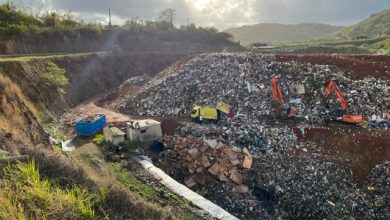
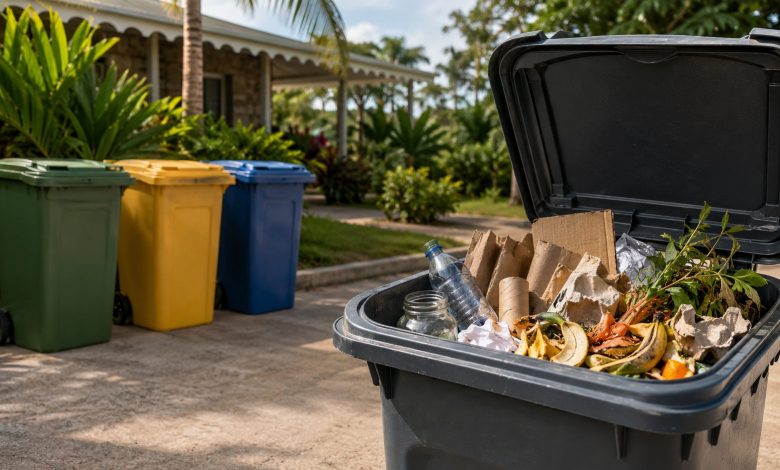
Once placed in the gray trash can, waste seems to have reached the end of its journey. However, a large portion of its contents could still be composted, recycled, or diverted to specialized collection programs. The MODECOM campaign conducted in 2024 by ADEME reveals that approximately two-thirds of Martinique’s residual household waste could be diverted from this stream—a potential estimated at 83,700 metric tons per year.
A trash can that's still far from being just a waste bin
To create this photograph, 146 samples were characterized on the territories of CAP Nord, CACEM, and CAESM. The study covers not only residual household waste but also dry recyclables, food waste, bulky items, certain types of commercial waste, and illegal dumping.
On average, residual household waste accounts for 347.1 kg per capita per year. This estimate is based on the composition observed during the 2024 campaign, applied to the 2022 collection volumes.
The contents of this trash can are broken down as follows:
- 32.6 % of food waste ;
- 29 % of paper, packaging, and glass covered by separate collection programs; ;
- 8.5 % of waste involved in fundraising efforts to be developed; ;
- 5.2 % of textiles, electronic waste, or special household waste as part of other existing collections; ;
- 24.6 % of residual waste.
Only 85.4 kg per capita is therefore considered to be truly residual waste. The rest consists of materials that could theoretically be avoided, composted, recycled, or sent to specific disposal channels.
Biowaste is the primary driver
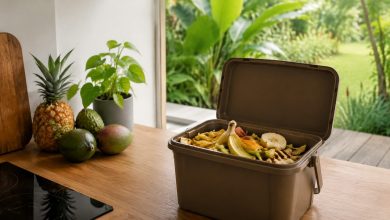
With 113.3 kg per capita per year, food waste is the main component of the gray trash bin. It includes food scraps, leftovers from meal preparation, unopened packaged items, and certain types of yard waste.
ADEME estimates that improving source separation could divert up to 33,000 metric tons of biowaste per year.
Preventing food waste could also reduce household waste by nearly 8,000 metric tons, while limiting household expenses. This second potential, however, is already included in the total bio-waste supply and should not automatically be added to it.
Some of these materials are already handled through local composting or separate collection programs. However, the majority still end up in the residual waste stream and are subsequently incinerated or landfilled.
The collection of food waste studied by MODECOM remains limited to part of CAP Nord and CAESM. It accounts for only about 17 kg per person per year, mainly yard waste. Its contents, however, comply with 92 %.
The challenge, therefore, is to combine several solutions based on the characteristics of the home: home composting, shared composting sites, door-to-door collection, or drop-off locations.
Sorting is improving, but recyclables are still not being collected properly
Paper, packaging, and glass bottles account for 100.8 kg per capita in household waste. Improving sorting could divert approximately 25,000 metric tons per year into the yellow trash bin and 11,500 metric tons to the glass recycling area.
However, collection rates remain low. In 2024, only 19 % of dry recyclables and 25 % of glass packaging are focused on proper collection. There has been real progress: in 2012, only 8 % of recyclables were properly sorted.
However, the yellow trash can still contains about one-quarter unwanted waste, or nearly 1,600 metric tons per year. This includes, in particular, glass, textiles, electronic waste, and materials that, at the time of the study, were covered by the expanded recycling guidelines.
Since 2012, the amount of eligible recyclables has increased by 2,628 metric tons per year. At the same time, sorting errors increased by 863 metric tons. These results, therefore, do not merely reflect residents’ behavior. They also raise questions about the clarity of the instructions, the accessibility of the facilities, and the organization of the collection efforts.
Turning Potential into Actual Capabilities
Finally, the study expands its analysis to include all identified waste streams, including bulky items, yard waste, and certain types of commercial waste. Based on approximately 200,800 metric tons considered, it estimates a theoretical potential of 73,832 metric tons for material recovery and 65,953 metric tons for organic recycling.
In addition to that, there is 51,631 metric tons that are likely to be diverted to energy recovery, and 4,975 metric tons subject to specific treatment under extended producer responsibility programs. Only 4,421 metric tons, or approximately 2 % of the total studied, are classified as waste for which no recovery solution has been identified.
These estimates are based on a best-case scenario. They assume that all materials are collected and properly sorted, and that the necessary facilities, supply chains, and markets are available.
Furthermore, the reference tonnages are from 2022 for most waste streams and from 2023 for waste from economic activities.
MODECOM therefore does more than simply assess the contents of trash bins. It provides a basis for adapting collection practices, organizing waste management systems, and determining the appropriate scale of facilities. In Martinique, a large portion of so-called waste «residual» are mostly materials that haven't yet been diverted to the proper recycling stream.
Source: ADEME – Characterization of Household and Similar Waste (DMA) in Martinique – MODECOM 2024 Campaign