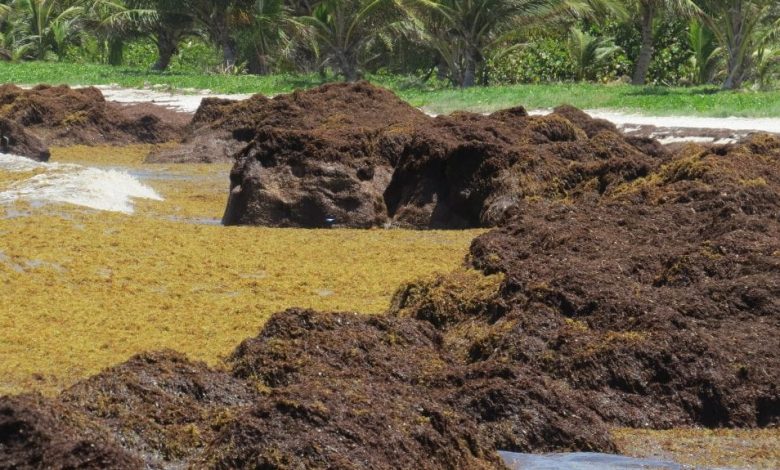
Since 2011, there have been repeated episodes of massive influxes of Sargassum seaweed, mainly along the Atlantic coast of Martinique, ranging in intensity until the phenomenal peak in December 2017. The stranding of this seaweed along the coastline is an absolute disaster for coastal residents, whether they work in the maritime or tourism industries or are simply local residents. This phenomenon is also an absolute ecological disaster for all species living along our coasts—corals, sea urchins, turtles, shellfish, and juvenile fish—all of which are impacted by the damage caused by the seaweed. Martinique’s biosphere is literally suffocating under the pressure of what are known as the «golden tides.» Their massive strandings on our shores and the effects of their decomposition represent unprecedented pollution of the water, air, and landscape, creating a genuine environmental crisis that affects people, animals, equipment, and everything that exists…
As a result of climate change, chemical soil pollution (fertilizers, pesticides), and the intensive exploitation of living organisms (intensive agriculture and livestock farming), this algae is, in a way, presenting us with a fait accompli! Because, for the time being, there is no answer to this question! This phenomenon persists while research is ongoing… Both government authorities and citizens are in a state of urgency, due to the lack of a long-term outlook on the phenomenon. And local residents, who are heavily affected, are struggling to understand why the solutions used by our Caribbean neighbors aren’t being implemented quickly!
Just as in traditional medicine, we treat the symptom, not the cause of the disease, and we do not take into account its many interconnections with the environment as a whole. For this phenomenon apparently has no local cause and now affects our entire region—from the Americas and the Caribbean all the way to the shores of West Africa! An international conference of countries in the greater region will be organized next October by the Prefect of Martinique, who also serves as the regional prefect, in an effort to share knowledge and experiences. Let us hope that the causes of this scourge will be investigated and that solutions can be found through regional cooperation. In early June, Environment Minister Nicolas Hulot announced his visit. Sargassum seaweed is gradually changing the perspective of people who had previously turned a blind eye to our lifestyles and consumption patterns—which are undoubtedly responsible for its proliferation.
By changing our perspective—precisely—and with advances in research, we may be able to turn this scourge into a resource …After all, Sargassum certainly has a great deal of potential. When it is alive in the ocean, before it washes ashore, it serves as a nursery and provides protection for many species; it is therefore beneficial in its natural state and non-toxic. It promotes biodiversity. We also know that it has the ability to absorb heavy metals, pollutants, and perhaps even chlordecone—it is bioabsorbent… Could it be used as a soil decontaminant? Gwanael Quenette of the DEAL, in a «State of the Art» The October 2015 report, published in conjunction with Associations Day, discusses potential applications—some under study and others currently being tested—that offer significant added value for composting. Holdex Environnement, based in Le François, has developed a process for composting this seaweed, as has a company in Sainte Lucie. This report highlights its potential as a biofuel for the energy sector and as a plastic substitute, as well as its properties in the cosmetics and pharmaceutical industries… What if sargassum were, after all, a solution to the pollution problems caused by human activity? One of our witnesses, an environmentalist, emphasizes the need to establish a specialized research laboratory locally in order to make faster progress, perhaps in cooperation with the other affected countries.
Sargassum fluitans and Sargassum natans, now a familiar sight in our landscapes, are sure to remain in the news!
Nathalie Laulé

Our «Sargassum» feature aims to provide an update on the phenomenon in June 2018, following the massive strandings of recent months. It was written by Kaylan Fagour, Mariska Desmarquis, and Nathalie Laulé.
TABLE OF CONTENTS:
1/ Scientific Presentation:
– Scenarios for future developments
2/ Environmental Assessment
-Current status of thea DEAL
– The Regional Health Agency’s guide, “Sargassum Algae Explained”
-A phenomenon closely monitored by Madinin’Air
3/ Impacts and Ongoing Actions:
–Ongoing initiatives, petitions, and requests from the public
–Testing of RIS’K Floating Barriers
–TRUXOR At-Sea Collection Trial
4/ Actions Taken by the Authorities
-The perspective of the mayor of Le François, a town that has been heavily affected
-The Sargassum Emergency Plan: Announcements by the Prefect
– Announcements from the Prefecture regarding ongoing pilot programs
-FB Prefecture on the resources currently deployed
5. Recycling Solutions
–Report on Activities Carried Out in the Caribbean
-Composting fresh seaweed with Holdex Environnement
–Cabex paneling for protection against H2S gas
See also:
-“Sargassum: A Scourge from Afar” by Ludovic Louis and Pascal Saffache