

With DéKLIk MAtinik 2026, the consortium Resilience Strategy offers much more than just a series of events: it is a space for discovery, learning, reflection, and hands-on experimentation, open to diverse audiences who are united by a shared need—that of Understand Better to Act Better.
Completely free of charge, this 2026 edition aims to speak the truth—without pretense or greenwashing—by drawing on the latest scientific knowledge, practical experience, Martinican culture, and the region’s resources. As part of this effort, the work carried out by Martine Lheureux deserves to be commended: steadfast, demanding, and deeply committed, he has for several years helped create a rare, coherent, and effective framework for awareness-raising and action in Martinique.
The DéKLIk MAtinik It thus stands out as an important event for Martinique, because it brings to the forefront of the discussion the issues that are already shaping our collective future: the livability of the region, adaptation to climate change, the resilience of our organizations, the role of living things, the transmission of knowledge, and the country’s ability to devise its own solutions.
An event that takes the realities of Martinique seriously
The strength of the DéKLIk MAtinik stems first and foremost from its positioning. Here, the goal is not to string together abstract statements or to repeat clichés. The ambition is clear: to help the people of Martinique to to stop denying the reality, to recognize the gravity of the situation, and to gain a clearer understanding of the upheavals currently taking place.
The project connects the planetary boundaries, the local crises, the question of water, the issues food, the health, the culture, the’economy, social vulnerabilities, and the need for adaptation strategies tailored to the region.
This approach gives the event a special significance. It does more than simply raise awareness about climate change in the traditional sense. It invites us to rethink the way to live in Martinique, to create, to pass on, to preserve, to cooperate, and to look toward the future. In this regard, it addresses issues that are essential to the island.
Martinique is facing more severe heat waves, intense rainfall, periods of water scarcity, and structural vulnerabilities in several sectors. Gaining a better understanding of these realities is not an option. It is a prerequisite for taking this matter seriously.
Four free events to reach different audiences
The 2026 edition will take place over four complementary phases, each designed for a specific audience.
DéKLIk M’Adapt Sciences
Thursday, March 26, 2026
6:00 p.m. to 8:00 p.m.
Amélie Plongeur Amphitheater, Bellevue High School, Fort-de-France
This session is intended for the scientific community, students, academics, and research organizations. It will focus on the presentation of the TRACC, the Reference Warming Pathway for Climate Change Adaptation, with the support of Météo-France Antilles-Guyana.
The goal is to provide researchers with insights, a methodology, findings, and tools that they can incorporate into their future work.
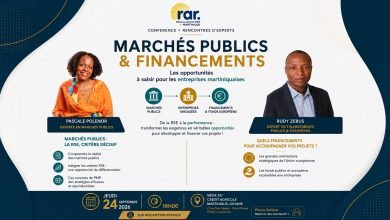
DéKLIk MAtinik PRO
Friday, March 27, 2026
8:00 a.m. to 1:30 p.m.
Appaloosa, Le François
This morning's event is intended for local governments, businesses, organizations, farmers, fishermen, job seekers, and, more broadly, anyone who plays a role in regional planning.
The discussions will be organized around three main themes: Adaptation and TRACC, multiple crises and robustness.
What makes this sequence unique is the emphasis placed on the’collective intelligence. It will not just be a matter of listening, but also of reflecting together and collectively drafting a call to action for adaptability.
DéKLIk MAtinik: A Citizen's Voice
Saturday, March 28, 2026
8:00 a.m. to 5:30 p.m.
Tivoli Eco-Center, Fort-de-France
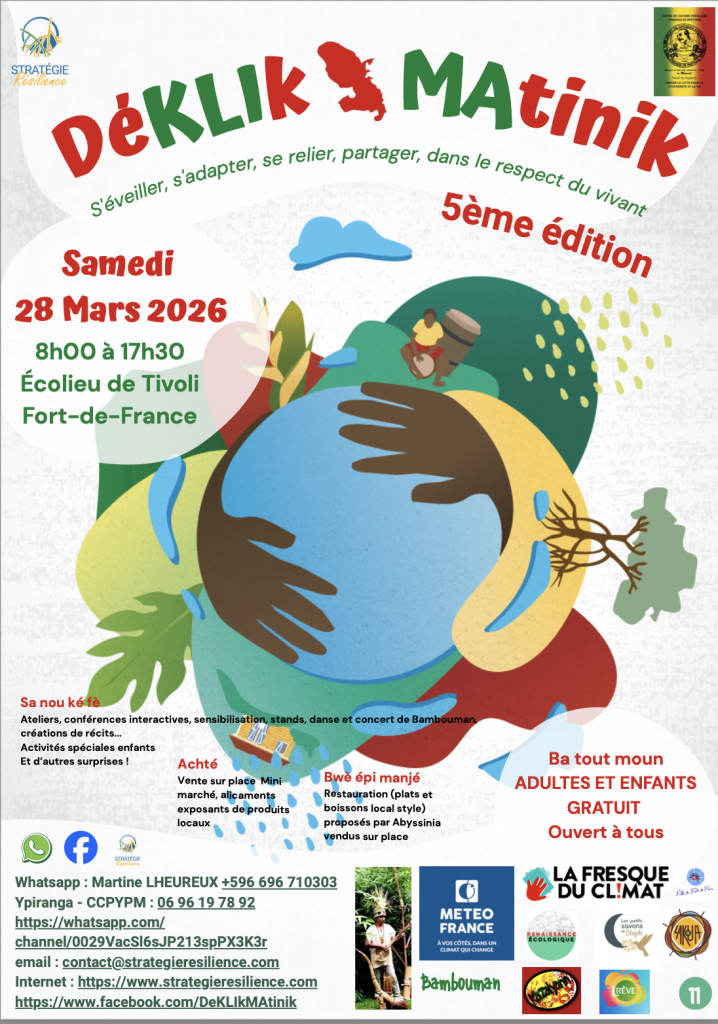
That’s the highlight of this year’s event. Open to everyone—adults and children alike—this intergenerational day is designed to be an immersive experience. It features a mix of lectures, meetings, hands-on activities, discoveries, awareness-raising, workshops, a mini-market, cultural exchange, and creative expression.
The choice of location is no coincidence: through its integrated approach and its experimental initiatives, the Écolieu de Tivoli already embodies a different way of connecting ecological, food-related, medicinal, cultural, and social issues.
DéKLIk M’Adapt Agrikilti
Thursday, April 23, 2026
Gros-Morne
This fourth event will focus on the agricultural sector, food processors, gardeners, farmers, and growers. Once again, the TRACC It will be presented there, with a focus on the challenges specific to agriculture and the adaptability of this sector, which is crucial for Martinique.
TRACC, a Key Tool for Thinking About Adaptation
One of the major contributions of this edition is its focus on the TRACC, as recently reported by Météo-France. This tool maps out reference warming scenarios to help regions plan their adaptation to climate change.
For Martinique, this means having more detailed data to anticipate future climate changes and consider their practical implications for water, agriculture, economic activities, infrastructure, health, and daily life.
This point is fundamental. All too often, public debates remain general in nature, whereas adaptation needs now require data that is specific to each region, understandable, and actionable. By integrating the TRACC in several scenes from the DéKLIk MAtinik 2026, the organizers shed light on a topic often reserved for specialists, while making it accessible to a wide range of audiences.
It is precisely this role as a mediator that gives the event its value.
March 28 in Tivoli: a full, lively, and meaningful day
Citizens' Day on Saturday, March 28 promises to be particularly enriching. It will not rely solely on top-down lectures. Instead, it will offer a journey in which understanding is also gained through experience.
The public will be able to discuss issues related to water, at adaptation, at the major systemic challenges, at the biodiversity, at the culture, at the spirituality and the place of life in our lives.
The discussions will also highlight the ancestral knowledge, cultural transmission, Creole, drumming, storytelling—in other words, everything that allows us to situate adaptation not only within scientific models but also within Martinican memory and sensibility.
The event will also feature many hands-on activities: composting workshops, low-tech projects, water filters, a dehydrator, a solar oven, a bike repair workshop, Bakoua weaving, games and obstacle courses for children, “tan jé an kréyol,” science experiments, storytelling, a mini-market featuring local products, and on-site food and drinks.
The website will also allow visitors to discover the Nutritional and Medicinal Plant Library as well as the experiments conducted at the’Tivoli Eco-Site.
The closing remarks by the Bambouman concert, nestled among the bamboo and along the riverbank, heralds the end of a day that reflects the event’s overall philosophy: connecting knowledge, practices, emotions, the local area, and living things.
A professional take that breaks away from the usual formats
The sequence of the March 27 The section dedicated to professionals also deserves attention. It is not limited to a technical conference. It examines organizational models, corporate and community strategies, approaches to accountability, the role of living organisms, systemic risks, and the responses that need to be developed in the face of multiple crises.
At a time when many economic and institutional stakeholders have not yet fully grasped the implications of the changes underway, this morning’s session offers a rare opportunity to reflect together.
The opportunity for collective intelligence and the desire to develop a joint advocacy effort give the meeting a practical dimension. This enhances its significance for Martinique, where building collective expertise on these issues is becoming essential.
An approach that embraces the alliance between science, culture, and knowledge transmission
One of the most interesting features of the DéKLIk MAtinik is its ability to avoid pitting one register against another. The event draws on scholarly research, particularly that of the IPCC and the climate data provided by Météo-France, but it also calls for respect for the ancestral knowledge, from the culture, from the’orality, from the Creole, memories, and folk traditions.
This connection is invaluable. It helps prevent awareness efforts from feeling detached or disconnected. It anchors the issues in the reality of Martinique. It also reminds us that adaptation will not be built solely on data tables, but also on stories, symbols, traditions, gestures, reinvented habits, and a more accurate vision of what connects us to life.
Committed partners and a strong local presence
The event is organized by a dedicated group. The report highlights the role of Resilience Strategy, by Météo-France, by Ypiranga, by the Tivoli Eco-Center, by the Appaloosa, from the Bellevue High School, by LAKOUA, volunteers from, among others, the Climate Mural, as well as numerous nonprofit, educational, and cultural partners.
This mobilization lends credibility to the project. It shows that this is not an isolated initiative, but rather the result of patient networking, cooperation, and outreach.
Martine Lheureux: A Driving Force for the Region
One name comes up time and again: that of Ms. Martine Lheureux. Her commitment appears to be the true backbone of the initiative.
Let’s be clear: she’s doing a tremendous job. Not just as a cliché, but because it’s rare to see a local initiative so consistently combine scientific rigor, educational outreach, openness to diverse audiences, respect for different cultures, the ability to bring partners together, and a commitment to fostering civic engagement.
In a region where climate and environmental issues are sometimes addressed in a fragmented manner, Ms. Lheureux helps build a clear, rigorous framework that is deeply rooted in the reality of Martinique. Her work, alongside the dedicated teams working with her, gives DéKLIk MAtinik a reach that extends far beyond mere event organization.
An important event for Martinique
The DéKLIk MAtinik 2026 is not just another event. It addresses fundamental issues that directly concern the future of the region. It invites us to look at Martinique as it is, with its vulnerabilities, its resources, its knowledge, its contradictions, and its possibilities.
She creates a space where the science, the citizens, the professionals, the farmers, the children, the volunteers, the artists and the keepers of memory.
That is precisely why it is important. Because it helps identify the challenges. Because it offers tools for understanding them. Because it rejects pretense. Because it challenges life, water, food, culture, and adaptation at the heart of the debate. And because it reminds us, with rare force, that Martinique must chart and build its own path to resilience.
In March and April 2026, the DéKLIk MAtinik It will therefore offer much more than just a program of lectures and activities. It will provide a way for us to take action together, to engage with our region in a new way, and to prepare for the future with greater clarity.
Philippe PIED