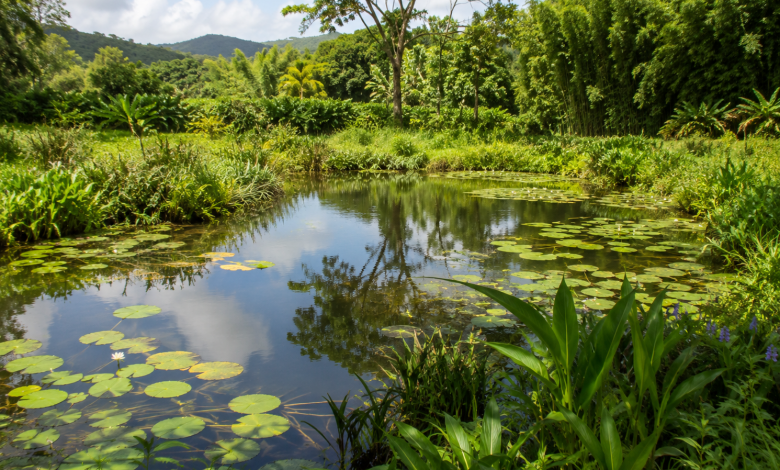
Although often inconspicuous and sometimes neglected, these ponds play an important role in the ecological balance of Martinique. The REMA II project plans to restore at least 80 of them in Martinique and Guadeloupe between 2024 and 2026, with the support of several partners, including the Albioma Foundation.
—
Small Wetlands with Essential Functions
A pond is not just a body of water. These small wetlands can temporarily retain rainwater, slow runoff, help regulate floodwaters, and limit erosion. They also help filter out certain pollutants found in surface water.
They also constitute refuges for many species. Amphibians, aquatic insects, birds, mollusks, and other animals find places there to feed, reproduce, or drink. When they are close enough together, these ponds form an ecological network that facilitates the movement of wildlife.
In a context marked by more frequent droughts and disruptions to the water cycle, preserving these areas can therefore strengthen the region’s resilience at the local level.
Martinique has a rich heritage in this area. In 2015, 1,178 ponds and lakes had been recorded on the island, mainly in the south, where climatic conditions are generally drier.
Across Martinique and Guadeloupe combined, the The Albioma Foundation reports that 4,600 ponds have been identified, forming a vast network of small wetlands that support biodiversity.
A Vulnerable Natural Heritage
Despite their usefulness, The ponds remain vulnerable. Some are gradually disappearing as a result of landfilling, urbanization, lack of maintenance, or changes in water flow.
Pollution, the degradation of riverbanks, and the abandonment of certain agricultural practices can also accelerate their deterioration. Prolonged periods of drought, for their part, can cause them to dry up and threaten the species that depend on these habitats.
Invasive Alien Species pose another threat. Plants such as water hyacinth and water lettuce can quickly cover the surface, alter the quality of the environment, and reduce the space available to native species.
The disappearance of ponds is often less noticeable than that of mangroves or large wetlands. However, it can lead to a gradual reduction in natural habitats and the ecological services they provide to the region.
REMA II: From Pilot Testing to Rollout
REMA II is a continuation of an initial phase launched in 2021 by the Tropical Wetlands Focal Point, coordinated by the French Committee of the IUCN.
This first step had made it possible to test various restoration methods at 12 ponds located in Martinique, Guadeloupe, and Saint Martin.
The projects carried out between 2022 and 2023 focused in particular on managing invasive species, restoring water to certain sites, restoring riverbanks, and maintaining vegetation.
These experiments led to the publication, in 2023, of a technical guide on the restoration and maintenance of ponds in the Caribbean. This guide is intended to serve as a reference for property owners, local governments, organizations, and managers wishing to take action in these environments.
With REMA II, the program is now moving into a phase of broader deployment.
At least 80 ponds to be restored in the West Indies
The project aims to restore and maintain at least 80 public or private ponds in Martinique and Guadeloupe.
Sites must first be identified and assessed to determine the most appropriate actions. Depending on their condition, the work may involve riverbank restoration, vegetation management, controlling invasive species, or improving their hydrological function.
Some biodiversity surveys and water analyses may also be conducted to assess the condition of the ponds and the effects of the operations underway.
However, the available information does not specify the exact distribution of the 80 sites between Martinique and Guadeloupe. Nor does it provide details on the municipalities in Martinique involved or the number of ponds that have already been restored.
The objective must therefore be presented as a shared goal for both territories, not as a goal that has already been achieved.
Train staff to ensure proper maintenance
Restoration is only the first step. Without regular maintenance, a pond can quickly fall into disrepair again.
REMA II It therefore provides training in ecological restoration methods for volunteers, managers, enthusiasts, and professionals.
Awareness-raising efforts must also be carried out among elected officials to ensure that ponds are given greater consideration in local policies on biodiversity, water management, and land-use planning.
Property owners, local governments, organizations, and nearby residents are encouraged to help preserve these sites. Agreements In particular, they will be able to oversee the maintenance of their property after the work is completed.
This local mobilization will be crucial for ensure the continuity of the initiatives already underway and prevent restoration efforts from remaining isolated incidents.
A grant of 74,160 euros from the Albioma Foundation
The Albioma Foundation brings 74,160 euros to the project. According to the funding provider, this contribution is intended, in particular, to cover the purchase of equipment and the implementation of restoration efforts in collaboration with managers, organizations, and local residents.
REMA II also receives other forms of public and institutional support, notably from the’French Office for Biodiversity. Albioma’s support is thus one component of a broader program led by the Tropical Wetlands Coordination Center.
In terms of size, the ponds may seem modest. However, their restoration addresses several important issues for Martinique: preserve biodiversity, improve local water management, and strengthen the region’s capacity to cope with the effects of climate change.
The program's success will now depend on the number of sites that are actually restored and on their long-term maintenance.
Source: ALBIOMA Foundation