
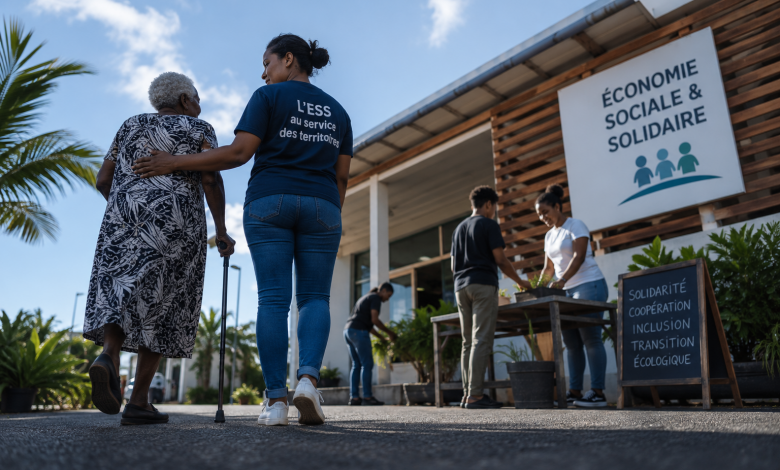
While the social and solidarity economy (SSE) is experiencing a slowdown in France, Martinique stands out as an exception. According to the latest economic report published by ESS France, the island recorded a 0.8% increase in salaried employment in the SSE from Q4 2024 to Q4 2025. This is a rare achievement in a national context marked by job losses and the weakening of many nonprofit and social sectors.
On a national scale, the picture is much bleaker. The social and solidarity economy (ESS) lost 10,447 jobs year-over-year by the end of 2025, a situation not seen since the pandemic. The decline has particularly affected nonprofit organizations, which alone accounted for more than 12,300 job cuts.
However, despite this overall trend, some overseas territories are holding up better. French Guiana even posted the country’s strongest growth, with a 3 % increase in jobs in the social and solidarity economy. In contrast, Guadeloupe (-1.3 %) and Réunion (-1.1 %) recorded sharp declines.
An economy that is often invisible, but essential to daily life
The social and solidarity economy (SSE) remains relatively unknown to the general public, even though it plays a major role in everyday life. In France, it accounts for 2.7 million employees, or 13.4 % of private-sector jobs.
Behind this acronym lie associations, mutual aid societies, cooperatives, and foundations. These organizations are active in very specific areas: home care, social services, community integration, sports, culture, health, food, training, and local services.
In Martinique, this sector plays a particularly important role. In a region facing challenges such as an aging population, social vulnerability, access to employment, and support for vulnerable populations, the social and solidarity economy often serves as a local point of contact.
Entire sectors under pressure
However, the ESS France report shows that several key sectors are going through a difficult period. The education sector, for example, lost 3,678 jobs over the past year (-1.6% Q3), particularly in continuing education and cultural education.
Home care services also continue to decline, with 1,723 jobs eliminated. This is a cause for concern given the aging population and the growing need for care.
The same is true for the arts, performing arts, sports, and recreation, which have also seen significant declines in participation.
Conversely, some sectors continue to create jobs, particularly health care (+2,766 jobs) and social and medical-social housing (+2,427 jobs). These trends reflect ever-increasing social needs across the regions.
Beyond the Numbers: A Matter of Social Cohesion
In his editorial, ESS France President Benoît Hamon warns of the concrete consequences of this weakening of the sector: «Beyond the statistics, it is social cohesion that is being undermined.»
This statement resonates particularly strongly in the overseas territories, where social and solidarity economy (SSE) organizations often carry out missions that neither the traditional market nor public services fully cover.
The progress observed in Martinique therefore appears to be an encouraging sign, but also a fragile one. Behind the positive figures, funding pressures, recruitment challenges, and economic pressures remain very much present.
In the coming years, the region’s ability to support its network of nonprofit organizations, cooperatives, and solidarity-based initiatives could become a major challenge for social and regional resilience.